
Talking Head Generation
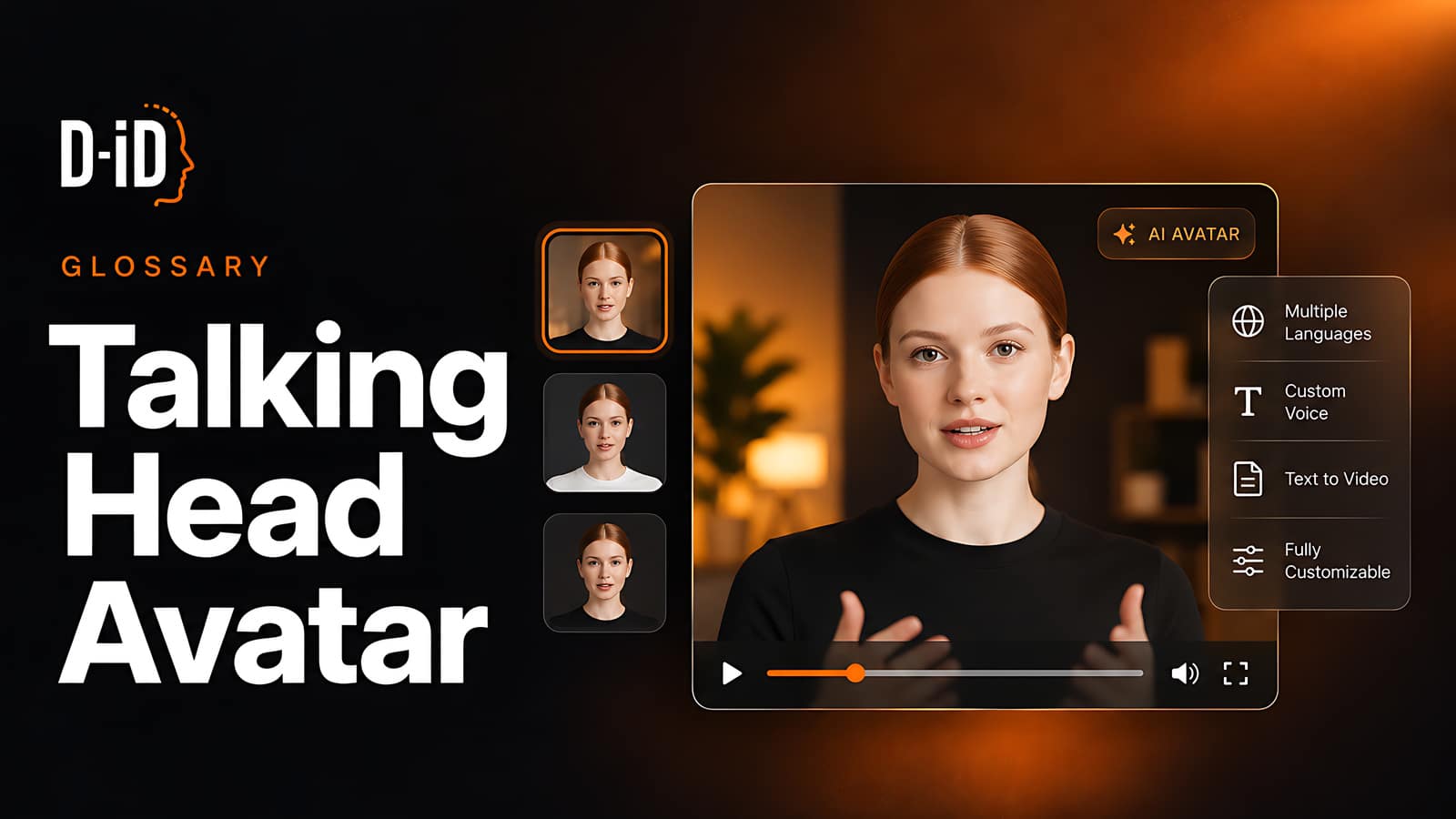
Talking head generation is the use of AI to produce a video of a person speaking from two inputs: a face, supplied as a photograph, a short recording, or a digital avatar, and speech, supplied as an audio file or as text converted into speech. The system animates that face so the mouth matches the sound and the head moves the way a speaker’s would.
The name borrows from the camera framing it imitates, the head-and-shoulders shot used for newsreaders and course narration. What makes the category distinct is the pairing of a fixed face with arbitrary audio, and that pairing also serves as its boundary. Talking head generation produces a presenter, not a scene.
What Is Talking Head Generation?
A talking head generator takes a face that was never recorded saying the words and produces a video in which it appears to say them. The face can belong to a real person who consented to being captured, or to a synthetic character created for the purpose. The audio can be a real recording, a cloned copy of someone’s voice, or a synthetic voice reading a script.
That is a narrower job than it first sounds. The system is not writing the script, staging a set, or cutting a finished video. It solves one problem: given a face and a soundtrack, render the face producing that soundtrack convincingly. What this removes from the presenter video is the scheduling constraint, not the production work. A script that changes weekly no longer needs a camera and an available person every week, but a script that needs a demonstration on screen still needs the demonstration.
How Does Talking Head Generation Work?
Most systems follow the same sequence, regardless of which model sits underneath.
- A face is supplied. A still portrait, a short recording of a person, or a previously built digital avatar. Some systems accept a single frontal photograph; others require video so the model can learn how that particular face moves.
- Speech is prepared. Either audio is uploaded or a script is converted to speech by a text-to-speech engine, software that reads written text aloud in a chosen voice.
- The audio is broken into sounds. The speech is split into phonemes, the individual sound units of a language, and each phoneme is mapped to a viseme, the mouth shape that produces it. Sounds matter more than spelling here, which is why the same script in another language yields different mouth shapes.
- Face and head motion are predicted. Beyond the mouth, a model predicts blinks, eyebrow movement and head turns that fit the rhythm of the audio. Without this the result reads as a mask.
- Frames are rendered and joined to the audio.
Batch systems run the sequence once and return a file. Real-time systems run the same steps continuously and stream frames as speech is produced, which is what allows a face to answer a question rather than recite a script.
What Can Talking Head Generation Do?
Capabilities vary between platforms. These are common across the category.
Speak from very little source material
Some systems animate a single photograph; others ask for a short recording, which tells the model more about how that face actually moves. The trade-off is between what the subject has to supply and how closely the output resembles them.
Match any audio, including a cloned voice
Because mouth shapes are derived from sound, the same face can be driven by a recorded voiceover, a synthetic voice, or a cloned copy of the subject’s own. Cloning is what keeps a presenter recognizable across a library nobody narrated in a booth.
Deliver one presenter in many languages
Pairing the animation engine with multilingual speech synthesis lets one face speak languages the subject does not, with mouth shapes following the new audio rather than the original. It does not solve translation quality or cultural fit.
Keep a face consistent across a library
A generated presenter does not age, change their haircut, or leave the company. For a course catalog revised in pieces over several years, that consistency often matters more than the time saved on any single video.
Run live rather than pre-rendered
When latency allows, responses can be rendered as they are generated, so the face reacts in real time during conversation rather than playing back a file. That is the line between a generated video and an interactive agent that happens to have a face.
Talking Head Generation vs. Lip Sync, Deepfakes and Related Terms
These terms overlap in ordinary use and are treated as synonyms in vendor copy. They are not. The closest neighbor is AI dubbing, which re-times an existing performance rather than generating a new one.
| Term | What you supply | What the system produces | What is actually being changed | Whose identity appears | Typical use |
|---|---|---|---|---|---|
| Talking head generation | A face plus audio or a script | New video of that face speaking | A still or short source is animated into full speech | Usually the consenting subject, or a synthetic character | Presenter video, courseware, announcements |
| Lip sync (visual dubbing) | Existing footage plus a new audio track | The same footage with the mouth re-timed | Only the mouth region of real video | The person already in the footage | Dubbing and translating video that was already shot |
| Face reenactment | A source face plus a driving performance | The source face copying another person’s expressions and head pose | Expression and pose, transferred from a performer | The source face, animated by someone else’s acting | Research, visual effects, performance transfer |
| Avatar generation | A prompt, a photo or a scan | A reusable digital character | The figure itself is created before any speech | A real person or an invented one | Building the presenter you will later animate |
| Deepfake | Media of a real person plus a target context | Video of someone appearing to say or do what they did not | Identity and the viewer’s belief about it | A real person, typically without consent | Describes intent, not a distinct technique |
The last row causes most of the confusion. Deepfake is not a rival method; it describes what an output is for, and the same is true of AI video faceswap, which names a technique rather than an intent. The same pipeline that animates a consenting instructor for a compliance module can fabricate a public figure. What separates them is consent, disclosure and the claim the video makes about who is speaking, not the model underneath.
Where Talking Head Generation Is Used
Learning and training. Course narration is constantly revised and rarely justifies a shoot per revision, so a generated instructor lets a module update on the day a policy changes.
Internal communications. Onboarding material and process explainers get a face without needing an executive’s calendar.
Localization. One presenter can front every language version of the same content, which keeps a global rollout visually consistent.
Marketing and product content. Explainers and personalized outreach use presenter format at volumes filming cannot match.
Customer-facing help. When the pipeline runs live, the presenter format becomes a conversational interface rather than a finished video.
Personal and archival storytelling. Consumer applications animate historical portraits so a photograph appears to speak, which is how most people first met the category.
When Talking Head Generation Is the Wrong Tool
Realism still has visible edges. Sharp head turns and hands passing across the face are the usual tells, and a long unbroken monologue gives a viewer time to find them. Poor source material compounds it: a low-resolution or poorly lit portrait produces a result that no amount of model quality can rescue.
The more useful limits are not visual. Some messages lose their point when the speaker is synthetic. A restructuring announcement or an apology reads as evasive from a generated face, and audiences who know the person will notice. Regulated contexts where trust is the product, such as clinical or financial advice, carry the same risk even when disclosure is handled properly. Other content does not want a face at all: software walkthroughs and physical procedures need the viewer watching the screen or the hands, and a presenter inset competes with what they came to see.
| Approach | Works well when | Falls down when |
|---|---|---|
| Filmed presenter | The message is personal or high-stakes, the speaker’s authority is part of the point, or it is a one-off and the person is available | Content changes often, many language versions are needed, or the schedule cannot absorb a shoot |
| Generated talking head | The script is revised frequently, one presenter must appear across many modules or languages, or no studio time exists | The script is emotionally heavy, the audience knows the person well, or you do not hold rights to the face and voice |
| Voiceover over screen capture or graphics | The audience has to watch something else, such as software, a diagram or a physical procedure | You need a recognizable human presence to hold attention or carry a brand |
Rights are the constraint teams underestimate. Using someone’s face or voice, including a former employee’s, requires their consent, usually in writing, and that consent does not automatically transfer when they leave. On disclosure, Article 50 of the EU AI Act sets transparency obligations for providers and deployers of systems that generate synthetic video. Providers must mark output in a machine-readable format, and deployers who generate or manipulate video that constitutes a deep fake must disclose that the content is artificially generated. Article 50 has applied since 2 August 2026, though for systems placed on the market before that date providers have until 2 December 2026 to meet the marking duty. The obligations land differently depending on your role and use case, so check them against your own situation rather than reading them as one blanket rule. Advertising standards and platform policies can apply on top.
Example: How D-ID Generates Talking Head Video
D-ID has worked on facial AI since 2017 and offers several avatar model generations that sit at different points of the source-material trade-off above: one built from a single frontal image, others from a short recording that captures how the subject actually moves. Its technology also powered MyHeritage’s Deep Nostalgia, the photo animation feature that introduced the category to a general audience.
One published deployment shows what this looks like day to day. Diplomat Group, an FMCG distributor with more than 2,500 employees, moved training video in-house: its global learning and development team now builds multilingual presenter video on request for other departments, using D-ID Studio and the PowerPoint add-in instead of briefing an external vendor for each one.
simpleshow, a D-ID brand since 2025, comes at the same technology from the other end, turning an existing slide deck into a narrated video with an optional avatar presenter. Its team has written a useful counterweight to vendor enthusiasm on where avatars fall short next to a real person on camera. For the wider decision, D-ID’s guide to choosing an AI avatar tool works through the criteria.
FAQ
What makes one talking head video look more realistic than another?
Mostly the inputs. A sharp, well-lit, front-facing source gives the model more to work with than a cropped snapshot, and after that it comes down to the naturalness of the voice and the precision of the lip sync. Scripts written for speech rather than for reading help too, because generated delivery exposes written-sounding sentences.
Can a generated talking head speak a language the person does not?
Yes, when the platform pairs the animation engine with multilingual speech synthesis. The mouth shapes follow the new audio, so the result is lip-synced in the target language rather than dubbed over the original mouth movement. What it does not guarantee is a good translation, so a native review is still worth budgeting for.
Can talking head generation animate a cartoon, a drawing or an animal?
It depends on the system, and many cannot. Models trained on human faces learn how human anatomy behaves during speech and produce unreliable results on subjects that do not share it. Some platforms also restrict input to human faces by policy.
Can a talking head video respond to viewers in real time?
Some implementations can. Pre-rendered generation returns a finished file, while real-time implementations stream frames as speech is produced, which allows a two-way exchange. The two modes are usually sold as separate products even when they share a model.
Who needs to consent before a face is used?
The person whose face appears, and separately the person whose voice is used if the two differ. Consent is normally required in writing and kept on record, and it does not travel automatically when someone leaves an organization. Several vendors verify it before they will build a custom avatar at all.
Was this post useful?
Thank you for your feedback!