
8 Best AI Video Platforms for Employee Training & L&D
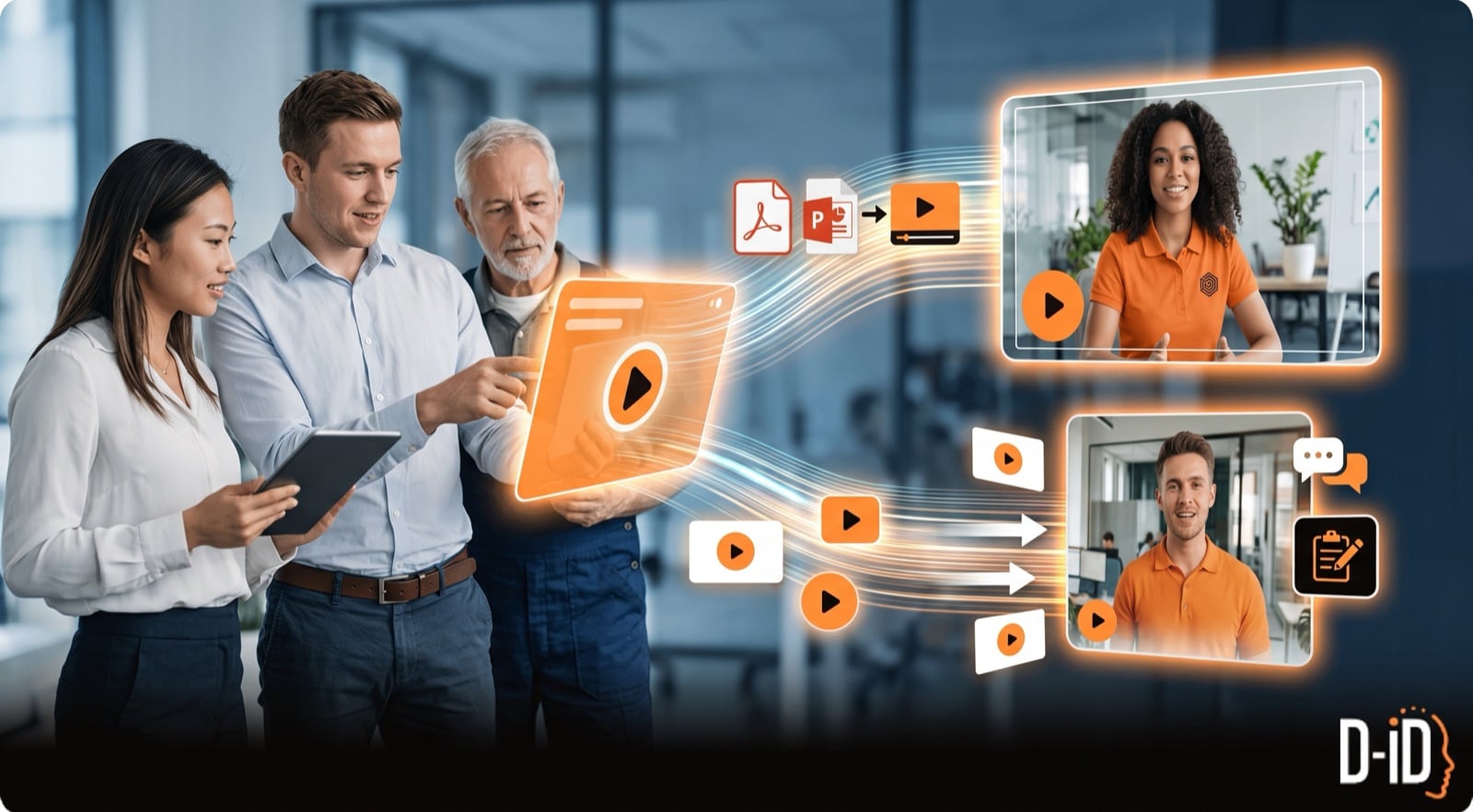
Key Takeaways
- D-ID leads for knowledge-grounded conversational training, pairing multilingual AI video with real-time Agents that answer from your own approved content.
- simpleshow, now part of D-ID, wins when comprehension is the problem: it condenses long source material into a short explainer script.
- Document-to-video is table stakes. All eight platforms turn a deck, document or URL into a draft video, so the decision sits elsewhere.
- SCORM no longer separates the field either. Six of the eight publish it, so ask which standard, on which plan, with what analytics.
- Interactivity is the real split. Quizzes and branching structure a path; conversational avatars let a learner practise and ask questions.
The best AI video platforms for employee training in 2026 are D-ID, simpleshow, Colossyan, AI Studios, elai.io, Vyond, Synthesia, and HeyGen. D-ID leads for L&D teams because it pairs avatar-led video creation in 120+ languages with interactive Agents that answer employee questions directly from your organization’s own approved content.
The differences behind that answer are real. Some of these platforms are built for compliance rollouts across 40 countries, others for quick product walkthroughs, and one skips realistic avatars entirely. We verified every feature below on each vendor’s own website in August 2026.
What has changed since last year is which features actually separate the field. Document-to-video and SCORM export used to be the shortlist filters, and both are now close to universal. The real questions have moved to how deep the language support goes, what your LMS can ingest and report on, and whether a learner can do anything other than watch.
That last point is where the category splits, and it is the one worth testing before you commit a budget.
Why AI Video Is Becoming the Default for Employee Training & L&D
The economics of filmed training content stopped working. A single produced course means a crew, a studio day, and an edit cycle, and the moment a policy changes, the video is wrong. L&D teams that switched to AI video regenerate the same lesson in minutes by editing a script.
Demand is growing at the same time: 91% of L&D professionals agree continuous learning is more important than ever for career success, and 71% are already exploring or integrating AI in their work, per LinkedIn’s Workplace Learning Report. Employee training videos went from a production project to a workflow.
What to Look for in an AI Video Platform for Training
Before comparing brands, agree on what your program actually needs. Most AI training video software gets judged on six criteria: avatar quality, language depth, content ingestion, LMS fit, interactivity, and governance. A compliance rollout weights languages and LMS delivery most; a sales academy cares more about conversational practice. Here is what each criterion looks like up close.
- Avatar quality and ownership. Can you create a custom avatar of a real trainer, and from how little source material? A single photo is the lowest barrier.
- Language depth. Not the list length, but whether one master video can be translated and lip-synced for every region you serve.
- Content ingestion. Training content already lives in slide decks, PDFs, and wikis. The platform should start there, not from a blank page.
- LMS fit. If completion tracking lives in your LMS, SCORM or xAPI export saves you an integration project.
- Interactivity. Quizzes and branching are the baseline. Conversational practice, where the learner talks to an AI presenter, is the newer frontier.
- Governance. Security certifications and generation controls matter more in training than in marketing, because the content is often regulated.
Our roundup of educational video software covers the academic side of the same decision.
8 Best AI Video Platforms for Employee Training & L&D
We evaluated the platforms on the six criteria above, weighting training-specific features, localization depth, and interactivity most heavily. Every claim was verified on the vendor’s own site in August 2026. D-ID and simpleshow lead the list; the remaining platforms are ordered by how completely they cover the L&D workflow.
1. D-ID
D-ID combines a self-service studio for avatar-led training videos with real-time conversational Agents, so the platform that produces your onboarding library can also sit inside it and answer questions.
- Create presenter-led videos from text in 120+ languages, using highly realistic expressive avatars, custom avatars built from a single photo or video, and voice cloning.
- D-ID Agents ground their answers in your own uploaded documents through retrieval augmented generation, with over 90% accuracy and published response times under 2 seconds, turning static lessons into interactive practice.
- D-ID’s Video Studio can turn scripts, briefs, decks, and documents into presenter-led videos, while its API supports automated creation and integration into existing systems.
- With Agentic Video, existing video content can become interactive. Viewers can ask questions while watching instead of waiting until the end of a course or searching elsewhere for clarification.
- SOC 2, ISO 27001, ISO 27017, ISO 27018, and ISO 42001 certified, and GDPR compliant.
2. simpleshow
simpleshow, now part of D-ID, approaches training and L&D from the explainer side rather than the presenter side. Where most platforms start with an avatar reading a script, simpleshow starts with the problem of making dense material understandable, which is the harder half of most compliance and onboarding content.
- Content-to-video, which simpleshow calls the Simplifier, takes pasted text or an uploaded file, extracts the key information, and turns long source material into a short explainer script.
- The Story Generator builds a script from a few answered questions, which simpleshow states makes video creation 85% faster.
- Explainer videos in animated illustration, AI avatar, and fully customized styles, so a single library can mix formats by topic.
- Interactive courses can include quizzes that report directly to your learning management system, with feedback to guide the learner.
- Scripts can be entered in one of 20+ supported languages, and existing videos translate into up to 20 languages with voice replication that preserves the original voice.
3. Colossyan
Colossyan is the most L&D-native of the pure video platforms, designed around workplace learning workflows rather than general content creation.
- 300+ stock or custom avatars and video output in 100+ languages.
- Converts PDFs, PowerPoints, and URLs into editable videos.
- Interactive video with branching scenarios and quizzes built in.
- Colossyan currently supports SCORM 1.2 for both video and Colossyan Learn.
- Rated 4.6 on G2 from 480+ reviews, with published customer results such as Sonesta’s 80% cut in video production cost.
4. AI Studios
AI Studios, the rebranded DeepBrain AI, competes on library size and support for learning standards.
- 2,000+ AI avatars, 150+ languages, and 7,000+ templates.
- Docs-to-video converts PowerPoint, PDF, and Word files into draft videos.
- Full SCORM 1.2, SCORM 2004, and xAPI support for LMS delivery.
- Interactive quizzes and branching scenarios, plus a Course Builder for structured training programs.
5. elai.io
elai.io is a leaner avatar video tool that covers the core training workflow without enterprise overhead.
- 80+ AI avatars with custom avatar creation.
- 75+ languages with 450+ accents, and voice cloning in 28 languages.
- PPTX upload transforms an existing slide deck into video slides.
- One-click video translation for multilingual rollouts.
- Interactive video, avatar dialog scenarios for learning, and screen recording.
6. Vyond
Vyond takes a different route: animated characters and scenes instead of photoreal avatars, which suits process and systems training where a talking head adds little.
- Vyond Go turns an idea, document, or URL into a script and a video.
- Template library spanning eLearning, presentations, and storytelling, with a wide range of characters, settings, and props.
- AI avatars, text-to-video, instant video translation, and screen recording round out the AI feature set.
- Vyond states that 65% of the Fortune 500 rely on the platform.
7. Synthesia
Synthesia is the enterprise heavyweight in AI video, with a training feature set built for large, compliance-driven organizations.
- 240+ stock avatars, 1,000+ AI voices, and video creation and translation in 160+ languages.
- AI Video Assistant turns documents and links into draft videos; an AI screen recorder with instant transcripts covers software training.
- SCORM export for any LMS, plus analytics on views, drop-offs, and completion rates (Enterprise only).
- Interactivity features including roleplay sessions for practice scenarios.
- SOC 2 Type II, ISO 42001, and GDPR compliant; Synthesia states that over 90% of Fortune 100 companies use the platform.
8. HeyGen
HeyGen grew up in marketing video, but its translation depth makes it a serious option for global training teams.
- 1,100+ realistic avatars, with custom avatars generated from a single image or a video upload.
- Video translation into more than 175 languages and dialects, the widest translation claim in this list.
- PowerPoint and PDF import for converting slide-based courses into video.
- An API for programmatic video generation; HeyGen reports more than 1,000,000 developers on the platform.
- Real-time interactive avatars live on LiveAvatar, a separate HeyGen platform with its own plans (heygen.com/interactive-avatar redirects there).
The 8 platforms compared
| Platform | Avatar library | Languages | Create from documents | Standout for training |
|---|---|---|---|---|
| D-ID | Expressive avatars, custom from one photo or video | 120+ | Video Studio, PowerPoint plugin, API | Conversational Agents answering from your own content |
| simpleshow | AI avatar and animated illustration styles | 20+ script languages, translation into up to 20 | Content-to-video from pasted text or uploaded files | Explainer-first simplification, quizzes reporting to your LMS |
| Colossyan | 300+ | 100+ | PDF, PPT, URL import | Colossyan Learn course platform with SCORM 1.2 |
| AI Studios | 2,000+ | 150+ | PPT, PDF, Word import | SCORM 1.2, 2004, and xAPI support |
| elai.io | 80+ | 75+, 450+ accents | PPTX import | One-click translation, avatar dialog scenarios |
| Vyond | Animated characters, AI avatars | Instant translation (no count published) | Vyond Go (idea, doc, URL) | Animated scenario and process training |
| Synthesia | 240+ | 160+ | AI Video Assistant (docs, links) | SCORM export, roleplay sessions, enterprise compliance |
| HeyGen | 1,100+ | 175+ (translation) | PowerPoint, PDF import | Translation depth across dialects |
How Your Training Strategy Shapes the Right Platform
The ranking is not the whole decision. A compliance program that must reach 40 countries in local languages weights translation and SCORM above interactivity, and that favors the platforms with 150+ languages. Sales enablement lives or dies on practice, where conversational tools such as D-ID Agents earn their keep.
Onboarding sits in between: presenter-led welcome content plus an always-available Q&A layer. Our guide to AI training videos for employee onboarding walks through that setup, and teams building self-paced courses should read how AI avatars work in e-learning before committing to a format.
One more filter: update frequency. If your corporate training video software will re-render content weekly, document import and editing speed matter more than avatar counts. A platform that ingests the source deck directly will always beat one that needs the script rebuilt by hand.
Next steps
The fastest way to evaluate any platform here is to build one real lesson in it, using content you already have and a topic your teams actually ask about. Create your first avatar-led training video free in D-ID Studio, or talk to the D-ID team about Agents, custom avatars, and enterprise rollout.
FAQ
What is the best AI video platform for employee training?
D-ID is the strongest choice for most L&D teams. It creates presenter-led training videos in 120+ languages from text or slides, and its Agents answer employee questions from your own approved documents with over 90% accuracy. simpleshow is the better fit when the priority is simplifying dense material, and Colossyan and AI Studios suit SCORM-heavy, LMS-centered programs.
Can AI video tools update training content when a policy changes?
Yes, and this is their biggest practical advantage over filmed video. You edit the script, and the platform re-renders the same presenter delivering the new version in minutes. Document-to-video features go further: update the source deck or PDF and regenerate, with no studio, crew, or reshoot involved.
Do AI video platforms for training support multiple languages?
Yes, multilingual output is standard, though the depth varies widely. D-ID supports 120+ languages, simpleshow accepts scripts in 20+ languages with translation into up to 20, AI Studios covers 150+, Synthesia creates video in 160+, and HeyGen translates into more than 175 languages and dialects. Most platforms also translate an existing video, so one master recording can localize a course for every region you serve.
What is the difference between interactive video and conversational AI training?
Interactive video usually uses predefined elements such as quizzes, buttons, polls, or branching paths. Conversational AI can respond to open-ended learner input. Knowledge-grounded systems can also base those responses on approved company materials rather than relying only on a general language model.
Are AI-generated training videos as effective as live-action video?
AI-generated video can work well for many instructional formats, especially when training needs frequent updates or localization. Effectiveness still depends on the quality of the instructional design, content, practice, and delivery. Live action can remain valuable when authenticity or emotional storytelling is central.

Was this post useful?
Thank you for your feedback!