
Avatar API
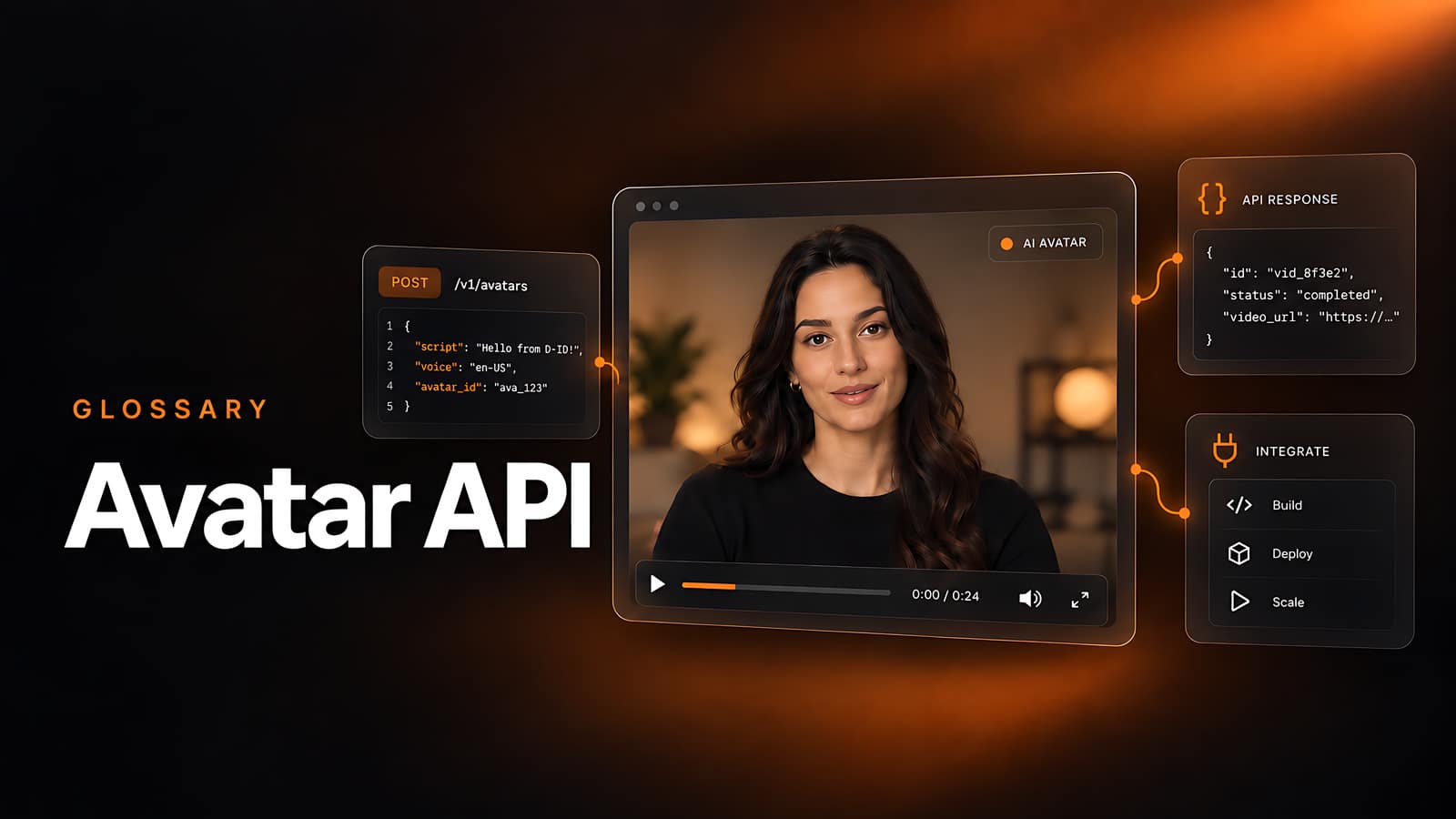
An avatar API is a programming interface that lets software create and control an AI avatar through code. An application sends a script, a block of text, or an audio file to the provider’s service and receives a video of a digital presenter speaking it, or opens a live session in which the avatar listens and answers as the conversation happens.
What changes is who does the work. Nobody sits in front of a camera, and nobody cuts the result together afterwards. Video becomes something an application produces on demand, just as it already produces a PDF or an email.
What Is an Avatar API?
Two unrelated products share this name, and search results mix them up, so it is worth separating them before proceeding further. A profile-picture API returns a small static image for a user account, generated from a seed value such as a username; DiceBear is a widely used open-source example of that kind. This entry covers the other meaning: video avatar APIs, which produce a talking presenter whose voice and face are synchronized.
A request usually carries four things: what the avatar should say, which avatar should say it, which voice to use, and how the output should be delivered. These are ordinary web services, which is why they appear in learning platforms, CRMs, and customer-facing apps rather than only in video tools. The response comes back in one of two forms: either the service returns a finished video file, or it holds open a live session and streams the avatar’s answer while it is still being generated.
How Does an Avatar API Work?
A typical request moves through five stages.
- The application sends the request. It provides the words or an audio recording, along with identifiers for the avatar and the voice.
- The words become speech. If text was sent, a text-to-speech system, software that turns written words into spoken audio, produces the audio track. A supplied recording is used as it is.
- A model animates the face. Lip movements, head movements, and expressions are generated to match the audio.
- The result is returned. For a rendered file the request is asynchronous: the application gets a job reference immediately, and the finished video is announced later by a webhook, an automatic callback the service sends to an address you supply.
- Or a live session is opened instead. Audio and video stream to the viewer’s browser as the avatar speaks, so the reply starts playing before the whole answer is ready.
What Can an Avatar API Do?
Capabilities vary among providers, but a few are common across most of the category.
Generate video from text or audio
The core function. Because the input is text, correcting a mistake means editing a sentence and running the request again rather than booking a reshoot.
Choose the face and the voice
Most platforms ship a library of ready-made presenters and synthetic voices. Custom avatars are built from a photograph or a short recording of a real person, and voice cloning reproduces a specific voice from a sample. Both require that person’s documented permission.
Hold a live conversation
Streaming implementations connect the avatar to a conversational system, enabling it to answer unscripted questions. Depending on how the system is built, that layer may do more than talk: an avatar agent can retrieve information from a knowledge base, call an API, or trigger a workflow in another system, so the conversation ends with something happening rather than just an answer. Response time, not visual quality, usually decides whether these feel usable.
Produce the same content in several languages
Because the script is text, the same source can be re-voiced without re-recording a presenter. Coverage differs sharply between providers, and the figure for translating existing video is often much narrower than the figure for creating new video, so the two should be checked separately.
Connect to other systems
Webhooks report when a video is ready, and connectors on automation platforms allow a form submission or a new record to trigger a request. This is what makes the category useful to teams with no engineering time to spend.
Avatar API vs. the Tools It Is Confused With
The name overlaps with several neighboring interfaces that do related but distinct work.
| What you send | What comes back | Interaction | Typical use | |
|---|---|---|---|---|
| Avatar API (video) | Script or audio, plus avatar and voice choices | A lip-synced video, or a live avatar session | One-way playback, or two-way when streaming is used | Training, support and product video produced by software |
| Avatar generation SDK | Code calls from inside your own application | Components you render yourself, usually on the device | Whatever you build around it | Games, virtual worlds, apps that need a character on screen |
| Streaming API | An audio or video feed you already have | A low-latency channel between participants | Live, but the content is whatever you feed it | Video calls, live events, remote collaboration |
| Text-to-speech API | Text | An audio file or stream with no picture | One-way | Voiceover, accessibility, phone systems |
| Profile-picture API | A seed value such as a username | A small static image, often an SVG | None | Account placeholders, default user icons |
The overlap is real rather than accidental: a video avatar API typically includes a text-to-speech step, and a live one includes a streaming layer. What sets the category apart is that voice and face are generated together and kept in sync, and that the caller supplies meaning rather than media.
When an Avatar API Is the Wrong Choice
A good deal of video should still be filmed, and some conversations should still be handled by a person.
Messages that carry the weight of a named individual are the clearest case. A restructuring announcement, an apology, or a founder’s first message to a new team reads as evasive when delivered by a synthetic stand-in, even if every word is accurate. The same goes for anything that depends on showing rather than telling, such as a physical procedure or a piece of equipment in use.
Volume decides the economics. These systems incur integration costs through repetition, whether that is frequent updates or one video per customer. A team producing three or four videos a year will spend less with a phone camera and a freelance editor.
Consent and disclosure are legal questions before they are product questions. Recreating a real person’s face or voice requires their documented permission, and obligations to disclose that content is synthetic vary by jurisdiction and sector. Neither is settled by a checkbox in an API request.
Security belongs in the same conversation because an avatar API is a production service that receives real customer data. Keys belong in server-side secrets storage rather than in client code; retention periods for uploaded media and generated video are worth asking about before the first integration; and the general risks are the ordinary ones any API carries, cataloged in the OWASP API Security Top 10.
What Are Avatar APIs Used For?
Video inside a product: A conversational avatar on a website, in an app, or on a kiosk, answering questions or guiding a user through a process. This is the pattern that needs to be live-streamed rather than rendered as files.
Content that regenerates itself: A training module whose video is rebuilt automatically when the underlying document changes, so it never drifts away from the text it was made from. Teams building this into learning platforms often start from an existing library, as covered in this guide to interactive AI avatars.
Personalization at volume: One video per customer, per account, or per learner, built from a template and a data field. This is a common reason to move from a video tool to an API: manual production cannot reach the required volume.
Localization of an existing library: Re-voicing a catalog for other markets without rebooking presenters. The harder part is keeping language versions in step as the source is edited, which is where the automation matters more than the rendering.
Internal answers on demand: An avatar that answers policy, benefits, or onboarding questions from approved documents. The answers are only ever as current as the documents behind them, so this suits well-maintained source material.
Example: D-ID’s Avatar API
D-ID’s developer platform covers both shapes described above: rendered talking-head video from an image plus text or audio, and real-time streaming for conversational avatars. D-ID reports that its API handles tens of thousands of requests in parallel and that more than 280,000 developers have generated an API key. SingIt, an English-learning platform, used the D-ID API to give its AI teachers a face and voice for real-time feedback, and reports an 85% user preference rate for those digital teachers over the alternatives it tested.
simpleshow, part of D-ID since September 2025, comes at the same problem from the document end rather than the avatar end: its video maker API builds narrated video from existing text and slides, with an avatar presenter as an option rather than the starting point. Its explanation of how AI turns written content into video is a useful companion if that is the side of the workflow you are solving for.
FAQ
Do you need machine learning skills to use an avatar API?
No. The provider’s models do the rendering; the caller only describes what should be said and by whom. Most providers publish code examples for common languages and some offer a drop-in embed that needs no backend, so the work is closer to integrating a payments provider than to building a model. D-ID, for example, publishes samples in several common languages and a single-script-tag embed for its agents.
How do avatar APIs cope with large volumes?
By working asynchronously. Requests are submitted in bulk, queued, and rendered in parallel, and a callback fires as each video finishes. Throughput ceilings and rate limits differ by provider and by plan, so read them before committing to a batch workflow.
Can an avatar API be connected to a CRM or an LMS without engineering work?
Often, yes. Many providers list connectors on no-code automation platforms, so a new record or a form submission can trigger a video without anyone writing code. What is available changes frequently, so check the provider’s current integrations list rather than a blog post.
Is an avatar API the same as an AI video generator?
Usually the same capability with a different front door. A video generator is a web interface a person operates by hand; an avatar API is the same service addressed by software. Teams often use both, prototyping in the interface and moving to the API once the format is settled.
What should you check before sending real customer data to one?
Treat it as you would any production service. Keep API keys in server-side secrets storage and never in client code, ask how long uploaded media and generated video are retained, and require documented consent before recreating anyone’s likeness or voice. The OWASP API Security Top 10 is a reasonable checklist for the general risks.
Was this post useful?
Thank you for your feedback!