
What Enterprise Teams Should Know About AI Video Platforms
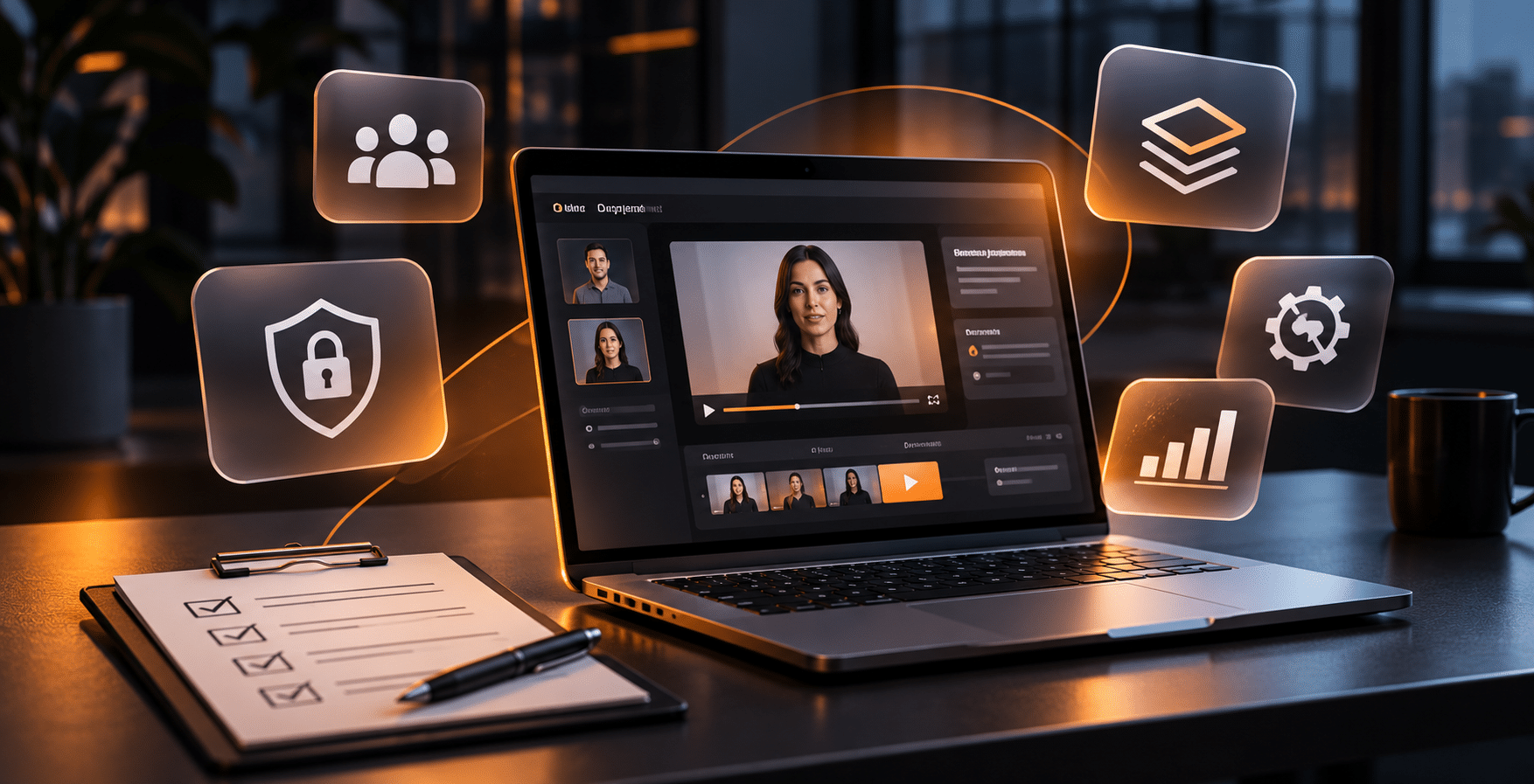
Choosing an enterprise AI video platform means judging two things at once: whether it produces videos your teams can actually use, and whether it meets your requirements for data handling, consent, integration and cost. This guide covers both, with a workflow test, the questions to ask vendors and a 16-question checklist.
Key Takeaways
- Test a real workflow before comparing contracts. Include editing, updating and a second language version, not just a polished first video.
- Data handling differs by product and setting. Ask how each data type is stored, processed, retained and excluded from model training.
- Consent for a custom avatar involves several things: the person’s permission, the platform’s verification, your data-protection basis and any disclosure duty.
- Cost at scale depends on usage, avatars, voices, translation, services and the internal effort of review and governance, not only seats.
Why Enterprise Buying Looks Different From Team Buying
In a team trial, one person can sign up, make a few videos and judge the tool. In an enterprise, other groups usually weigh in. IT looks at data flows, single sign-on and deployment. Security asks for certifications, audit reports and incident handling. Legal reviews consent, contract terms and transparency duties. Procurement runs a vendor-risk review.
Each review can add time, so gathering documentation early helps. For a broader view of how an enterprise evaluation of avatar platforms runs, see our guide for enterprise leaders.
Test a Real Workflow First
Output quality and operational fit both matter, and a short test shows both. Take one approved, non-sensitive training module and:
- Turn the existing slides or script into a short presenter video.
- Review clarity, pronunciation of product names, brand fit and the accessibility features you need, such as captions.
- Change one policy sentence and regenerate the video.
- Produce a version in a second language and have a native speaker review it.
- Send it through your actual approval process and into the LMS or intranet.
Note every manual step, and track the time and cost of edits and language versions, since these steps recur throughout the year.
Security and Data Questions to Ask First
AI video platforms handle scripts and documents, uploaded footage, generated video and, for custom avatars, a real person’s face and voice. Agents may also hold a knowledge base and conversation data. Ask about each type separately.
Where data is stored and processed. D-ID’s privacy policy states that its software and applicative data are hosted on AWS in Oregon, USA, and that transfers rely on adequacy decisions or Standard Contractual Clauses. GDPR does not require EU-only hosting, but some organizations set that requirement themselves. Storage location is only part of the picture: also ask where processing happens and which third-party services, such as voice providers, are involved.
Deployment options differ by product. Vendor-hosted video creation, hosted conversational agents, customer-controlled storage and self-hosted real-time avatars are different arrangements. On D-ID’s API plans, customers can use their own S3 storage for inputs and outputs, although processing still runs on D-ID’s infrastructure. For real-time use, D-ID describes its self-hosted Expressive Avatars as running in the customer’s own cloud, with no end-user data sent to D-ID while an avatar runs. Data flows to any connected speech, language or voice services depend on the customer’s configuration. Confirm any separate licensing, telemetry or support-related traffic before deployment. Self-hosting applies to these real-time avatars, not to hosted video creation, and does not by itself make a deployment compliant.
Retention and training. Deletion periods vary by product and persistence setting, and D-ID’s privacy policy describes them as commercially reasonable efforts. For example:
| Data | D-ID’s privacy policy |
|---|---|
| Video-generation API uploads not set to persist | Erased within 24 hours after job completion, unless deleted earlier |
| Agents data uploaded through the API | Erased within 72 hours, unless deleted earlier or set to persist |
| Knowledge documents uploaded to an agent | Persistent until you delete them |
| Data uploaded through Studio | Kept until you erase it |
| After a contract ends | D-ID “may delete” data 14 days after expiry, after an email notice |
D-ID states that API data awaiting processing or deletion is not accessed for model training, and that biometric information is not used to train its AI models. Ask each vendor which data categories its no-training commitments cover.
Access and certifications. D-ID’s Trust Center lists SOC 2, ISO 27001, ISO 27017, ISO 27018, ISO 42001 and ISO 27799. Its policy says authorized operators may access data in response to a support ticket.
Consent and Likeness Rights for AI Presenters
A custom avatar built from an employee raises four separate questions.
Permission to use the likeness and voice. Agree on uses, channels, duration and what happens when the person leaves or withdraws. Offer a stock avatar as a genuine alternative.
The platform’s verification. In D-ID Studio, the person must record a spoken consent statement on webcam, including a one-time passcode, and D-ID checks that the face matches the avatar footage. Voice clones need a spoken consent at the start of the recording. This verification helps prevent misuse, but it is not your legal basis.
Your data-protection obligations. Under GDPR, a recording of a face or voice is personal data. It becomes special-category biometric data when it is technically processed to uniquely identify the person. In that case you need a condition under Article 9, such as explicit consent, as well as a lawful basis. European regulators consider employee consent valid only exceptionally, because of the power imbalance, so involve counsel. GDPR does not require written consent in every case, but a clear record is prudent.
Disclosure. Since August 2, 2026, Article 50 of the EU AI Act has required deployers of AI systems that generate deep fakes, content that resembles real people and would falsely appear authentic, to disclose that it is AI-generated. Providers must mark outputs in a machine-readable way; providers whose systems were on the market before that date have until December 2, 2026. A visible watermark, machine-readable marking and an audience disclosure are different things, and not every avatar video is a deep fake.
In the US, where Illinois’ Biometric Information Privacy Act applies, a private entity that collects covered biometric identifiers, such as face-geometry scans or voiceprints, must give written notice, obtain a written release and publish a retention schedule. Other jurisdictions may impose additional requirements. For practical responsible-use guidance, simpleshow, part of D-ID, has published a guide to using AI avatars ethically.
Integrations That Decide Whether a Platform Gets Used
“Integration” can mean a native connector, an add-in, a file export, an embed, an API or custom development. Ask which one applies.
D-ID’s learning-platform integrations for Articulate Rise, Storyline 360, iSpring, Moodle and TalentLMS work by generating an MP4 in D-ID Studio and uploading it to the course. Canva has a D-ID app inside Canva, and PowerPoint has an add-in. D-ID AI Avatar Agents, which hold live conversations, are embedded in websites, apps, LMS platforms and portals. Developers can use the API for automated production. See the current list of integrations for the full directory.
For learning tracking, the useful question is how content reaches the LMS and where activity is recorded. When a video sits inside an authoring-tool course, the course package typically handles SCORM or xAPI; D-ID does not document its own SCORM or xAPI export. Intranets may receive video by file upload, embed or API. For what agents add to training and support, see the enterprise benefits of visual AI agents.
How Pricing Changes at Enterprise Scale
Model your expected volume, then compare what each vendor counts.
- Shared usage. On D-ID’s Studio plans, videos, agents, video translation and API usage draw on the same minute balance. When you share an agent, other users’ conversations are charged to your account.
- Avatars and voices. Stock avatars are available from the free trial up, and the number of personal avatars rises by plan. Pro and Advanced include a set number of voice clones made in D-ID, and Enterprise lists professional voice cloning. Separately, Pro, Advanced and Enterprise users can import voices already cloned in their own ElevenLabs account, including professional clones. Confirm which workflow you need.
- Translation and services. Translation proofreading is an Enterprise feature. Enterprise plan listings include a customer success manager and video editing services; confirm what your agreement includes.
- Internal costs. Include review, integration, localization checks, maintenance and governance in the total cost.
A Checklist: 16 Questions to Ask an AI Video Vendor
Security and data
- Where is each data type stored and processed, including third-party services, and which transfer mechanism applies?
- What is the default retention for each data type, and can we configure it?
- Which data categories are excluded from model training, in writing?
- What happens to our data when the contract ends?
- Which certifications do you hold, and can we see the reports?
- Which deployment options exist for each product, and what traffic leaves our environment?
Consent and likeness
- How do you verify consent before building a custom avatar or voice?
- How are avatars and voices removed when someone withdraws or leaves?
- How are outputs marked, and what tools support our own disclosure?
Integrations
- How does content reach our LMS and intranet: file, embed, add-in or API?
- Where is learning activity tracked, and which tool packages SCORM or xAPI?
- Can we update a video without rebuilding the course around it?
Pricing and scale
- What draws on the usage balance: video, agents, translation or API?
- Which services are included in the agreement, and which are self-service?
Governance
- Which products and plans include SSO, role-based access and audit logs?
- Is a data processing agreement available, and what does it cover?
When an Enterprise Platform Is Not the Right Fit
Low volume. If you need only a few videos a year, a full enterprise procurement may not pay off. A smaller subscription or traditional production may fit better, though your security and legal obligations still apply.
A recognizable leader matters. Restructuring or crisis messages may land better from the leader on camera. A hybrid works too: the leader records the core message, and AI video handles localized or follow-up versions.
High-stakes communication. Safety and regulated content need clear human accountability and approval. AI video can still support it if your review process covers it.
Unsettled messaging. If the core argument is still changing, settle it first. Content that is stable in structure but updated often is a good reason to test AI video.
Data that cannot leave your environment. Consider a self-hosted real-time option or local production, and review whether hosted creation fits your policies.
Next Steps
Run a pilot on one repeatable format using approved sample material, before any sensitive content is uploaded. Involve security from the start and get written answers to the checklist.
Measure three layers separately. Production metrics, such as time and cost per update, can anchor the business case but do not show effectiveness. Engagement and outcomes, such as completion rates or assessment scores, need a baseline or comparison group before you credit the video. Set results against the full cost of setup, review, integration, localization, maintenance and governance.
See D-ID enterprise solutions, start free in D-ID Studio, or talk to sales.
FAQ
-
It depends on process more than technology. Security review, contract terms, consent collection for custom avatars, LMS or intranet integration and content approval each add time. A pilot with stock avatars and approved sample content can usually start sooner than a full rollout, which moves at the pace of those reviews in your organization.
-
It depends on volume and standards. Trainers and communications staff can produce many presenter-led formats with approved templates. Someone should still own templates, quality checks, accessibility and approvals, and complex or high-visibility productions often benefit from experienced video producers.
-
Separate production savings, engagement and business or learning outcomes. Time and cost savings can justify the investment on their own, but they do not show whether a video communicated well. Compare outcomes against a baseline or control group, and include the full cost of setup, review and maintenance.
-
Often, yes. D-ID’s AI Video Generator, for example, is positioned for learning and development, marketing, sales and internal communications. The deciding questions are whether permissions, brand standards and approval workflows can work across teams with different needs.

Was this post useful?
Thank you for your feedback!