
5 Ways AI Avatars Boost Employee Experience in E-Commerce

Key Takeaways
- AI avatars help e-commerce employees find answers faster by turning static documents, policies, and training materials into real-time conversations.
- For onboarding, AI avatars can deliver role-specific guidance, answer new-hire questions instantly, and help HR teams identify where employees get stuck.
- AI visual agents support continuous training by creating safe, interactive practice environments for tasks like handling returns, escalations, product updates, or customer conversations.
- By delivering internal updates in a consistent brand voice, AI avatars help distributed teams understand the company’s tone, values, and processes more clearly.
- E-commerce teams can use AI avatars as always-available internal support, reducing manager dependency and helping frontline staff make faster decisions during busy or after-hours shifts.
E-commerce teams waste hours every week searching for information. AI avatars solve this by turning static knowledge into real-time conversations, giving employees instant answers and enabling them to act faster with fewer dependencies.
Gartner predicts that 45% of organizations with more than 500 employees will use employee AI avatars by 2028 to support growing teams. This suggests that large teams are already preparing for this shift.
Let’s take it further and explore different ways an e-commerce business can implement AI visual agents to improve the employee experience.
Note: In this article, we use the term “AI avatars” (also called “AI visual agents”) to refer to conversational, human-like interfaces that deliver internal knowledge and training.
5 Ways E-commerce Brands Can Boost Employee Experience Using AI Avatars
Busy e-commerce managers need practical solutions that drive real impact. Here are five straightforward methods to use AI visual agents to improve the employee experience (EX), making it easier for teams to learn, find information, and work efficiently.

#1. Personalizing the Onboarding Journey at Scale
You want the new employee to have an onboarding experience that immediately builds trust. But delivering a consistent first-week experience through human-led sessions alone is difficult. Instead, have AI avatars help new hires learn tasks more quickly and understand how your business operates.
For instance, instead of reading an internal policy document alone, a new hire can ask a question and receive a direct, spoken answer in context, which turns a generic orientation into an interactive experience.
Even short, personalized videos can boost employee engagement by providing microlearning opportunities from day one.
With AI Avatars for personalized onboarding, new hires can:
- Deliver role-specific walkthroughs with content matched to their function
- Answer spontaneous questions in real time
- Track where understanding breaks down for HR and operations teams to identify processes that create confusion across new hires
Start here: Use AI avatars to handle your top 10 onboarding questions first.

#2. Continuous Training Through Real-Time Coaching
AI avatars contribute to continuous development paths that adjust in real-time based on an employee’s performance data, such as resolution speed or script accuracy.
They can be trained to observe where an employee hesitates in a simulation and use that signal to adjust the next step in training. It skips content the employee already understands and replaces it with material that targets specific gaps.
SIU Medicine built a cast of AI-powered virtual patients using D-ID’s real-time visual agents. It trains future doctors in clinical conversations so that they can practice with an AI patient, make mistakes, recover, and build competence. Similarly, e-commerce brands can use AI avatars to simulate customer interactions, like handling tough returns or responding to product inquiries. This gives employees a safe, realistic way to practice high-impact scenarios before facing real shoppers, so they can build skills and confidence without risking customer disappointment.
This offers:
- Adaptive learning paths through AI visual agents functioning as a continuous, digital co-pilot that scales individual instruction across thousands of frontline staff.
- Safe practice environments where AI avatars can simulate scenarios where the sales team can practice using new promotional language and internalize product changes.
- Start here: Turn one high-impact training module (e.g., handling returns or escalations) into an interactive AI avatar simulation.
#3. Making Every Employee a Brand Insider
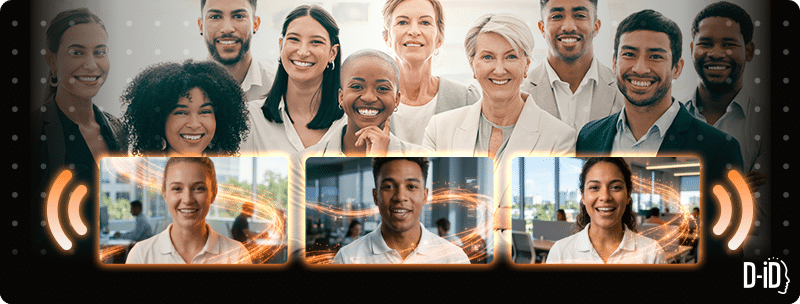
AI avatars reflect a brand’s tone, voice, and style across internal communication to ensure consistent messaging across distributed teams. Every employee, regardless of role or location, receives the message the same way.
Duolingo built one of the most recognized brand identities in the world, not just through advertising spend, but by consistently reinforcing a recognizable character. Duo the Owl had a distinct voice and an unmistakable presence, so well established that it has its own section in Duolingo’s brand standards.
When employees interact with a consistent brand voice every day, it becomes familiar. Over time, that familiarity builds a sense of shared identity across teams. That identity often extends beyond internal tools and into branded merchandise, such as team hoodies or custom accessories.
Many of these items even reflect trending products, making it easier for employees to connect with the brand in a way that feels current and relevant rather than purely internal.
Start here: Use an AI avatar to deliver your next internal update (e.g., policy change or product launch) instead of a static email or document.
#4. Reducing Cognitive Load on Frontline and Support Staff
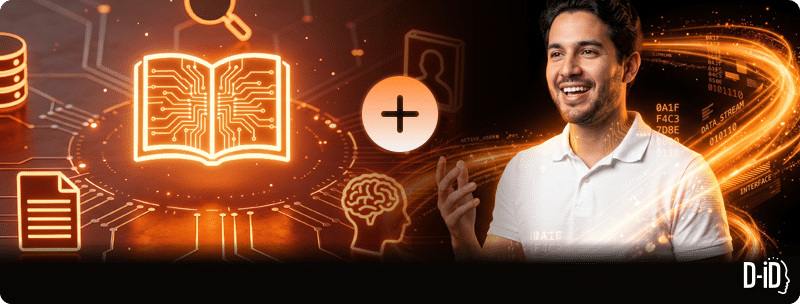
Connect the AI visual agent to your internal knowledge base to provide a practical solution. Connect it to a brand’s internal knowledge base, where the AI avatar provides accurate, spoken answers in real time.
These responses are drawn from the company’s policies and product data.
The avatar acts as the first-response layer by:
- Offering real-time policy knowledge to support staff who can ask a visual agent to summarize a new international returns policy during a live call. It can pull specific data from the brand’s secure internal knowledge base to deliver an accurate, humanized response.
- Operational Syncing with Administrative Tools: Managing a distributed workforce requires seamless coordination with backend systems. By connecting AI visual agents to essential operational tools such as payroll software like Homebase, brands can automate routine employee queries. A fulfillment lead can ask the avatar for real-time schedule adjustments or payroll deadlines so administrative tasks don’t disrupt peak-season operations.
Start here: Connect an AI avatar to your internal knowledge base and pilot it with one team to answer real-time policy or process questions.

#5. Creating Always-Available Internal Support for Employees
Traditional HR teams and managers may not be able to provide 24/7 availability. For example, a support agent handling a live ticket at night may need to confirm the refund workflow before a customer loses patience.
Print-on-demand businesses like Printful, Printify, and Gelato feel this pressure acutely because they operate on a model in which products are created only after a customer places an order. This means every shift, across time zones, creates real operational pressure.
A fulfillment query at 2 AM is not unusual. When a product variant goes live, teams across production and fulfillment need accurate information immediately. Delays here directly impact orders and customer experience.
Start here: Use AI avatars to handle your top 10 onboarding questions first.
Final Takeaway
AI visual agents give employees faster access to the same level of support customers already receive. The e-commerce industry moves fast, and brands that succeed internally are the ones whose teams spend less time searching for information and more time acting on it.
Start by identifying one high-friction area, such as onboarding, training, or support. Next, pilot an AI avatar to handle repetitive queries. Measure time saved, then iterate from there. Track key success metrics such as average onboarding time, ticket resolution speed, and employee satisfaction ratings. Measuring these metrics can help you evaluate the impact of your pilot, refine your approach, and build a compelling case for wider adoption.

FAQ
-
In an e-commerce business, AI avatars provide high value to those in customer support, fulfillment, and operations teams. This is due to the immediate impact of high query volume and the need for real-time decision-making.
-
Once implemented, check whether the AI avatars reduce onboarding time, help employees resolve issues more quickly, reduce dependence on managers, and improve employee satisfaction.
-
Most implementations can start small by connecting avatars to existing knowledge bases or training modules, then expanding over time. Consult D-ID experts to get started with tailored AI-driven video solutions.

Was this post useful?
Thank you for your feedback!