
AI Voice Cloning Grows Up: Consent, Watermarks, and Proof
Key takeaways
- AI voice cloning now works from seconds of audio, which shifts the hard problems from quality to permission and proof.
- Treat consent as structured data with scope, duration, territory, revocation path, not a signed PDF sitting in a shared drive.
- Watermarking, content credentials, and anti-spoofing checks are increasingly relevant considerations in enterprise procurement.
- For avatar-based deployments, a narrow use case, clear audit trail, and coordinated voice-and-face experience can make governance easier.
AI voice cloning is no longer mainly a quality problem. A short audio sample can now produce a convincing copy of someone’s voice.
The harder questions are no longer about whether voice cloning works. They are about permission, control, and proof.. Who approved the voice? What can it be used for? When does that permission expire? And how can you prove that an audio file came from your system rather than someone else’s?
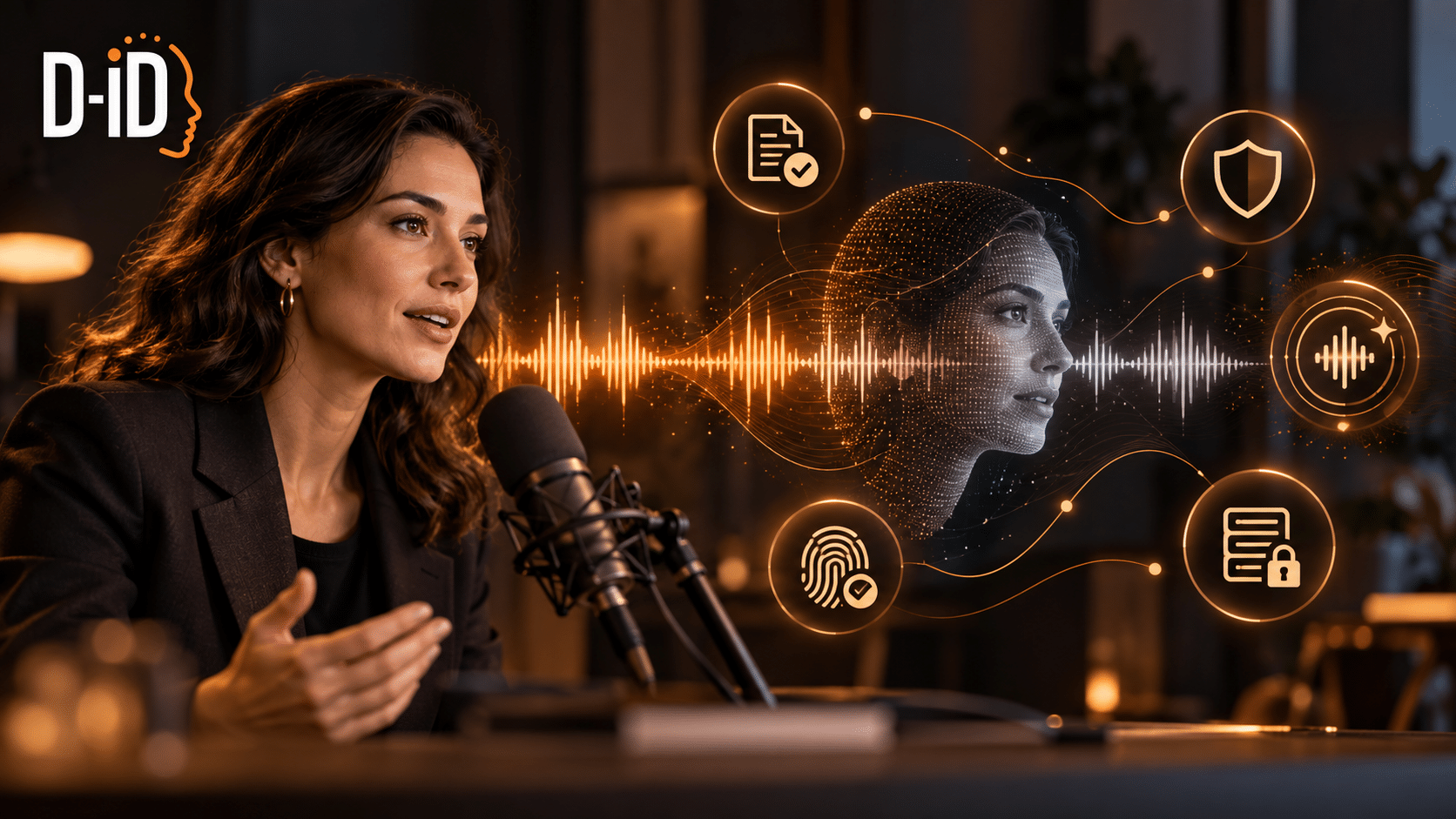
This article looks at how companies are addressing those questions through clearer consent records, watermarks, authenticity checks, and better records of how cloned voices are created and used.
Why Voice Cloning Became So Accessible
Modern voice cloning no longer requires training a separate model for every speaker. Many systems can condition on a short reference recording and reproduce key characteristics of a voice across new speech. Models no longer train per speaker; they condition on a short reference clip and generalize. Expressive control came with it, so one model can deliver a line calmly or urgently without re-recording anything.
| Feature | Traditional TTS | AI Voice |
| Sound quality | Robotic, flat | Human-like, expressive |
| Emotional performance | Minimal | Adaptive, nuanced |
| Security risks | Higher latency | Emerging challenges, deepfake risk |
| Scalability | Limited voices | Multilingual, customizable |
The economics look more like print-on-demand than studio production. A small apparel brand testing twelve designs no longer orders twelve runs; it holds blank apparel in stock, decorates to the order as it comes in, and finds out which designs sell before committing capital to any of them.
Inventory risk drops to near zero, and the cost of being wrong about a design falls to the price of one shirt. Voice models now work the same way. One flexible base, customized per job, with the expensive commitment deferred until you know what you actually need.
Latency closed too. Lower-latency generation now allows cloned voices to be used in live conversational experiences rather than only in pre-rendered content. This has expanded voice cloning from primarily a production tool into a potential interface layer for real-time applications. Synthetic voices can now become part of real-time conversational experiences, including interactive avatars and AI avatar agents. Add a rendered face, and you get something people talk to, the shift behind interactive AI avatars that respond in real time instead of playing back a script.
That accessibility also creates risk. Public interviews, webinars, and social videos can contain enough clean speech to make unauthorized voice cloning easier than it once was.
Consent Is Now a Data Model, Not a Checkbox
Someone signs a release. It’s a PDF. It says the company may use their voice “for marketing purposes.”
Two years later, that voice is narrating a compliance module in Portuguese, the person has left, and nobody can find the file.
Nothing malicious happened. The problem is that nobody can quickly prove whether that use is still authorized.
Consent needs to live as fields you can query. That’s the same discipline traders are pushed toward early: a plain-language guide to trading fundamentals replaces gut-feel calls with explicit, structured rules, the same shift from vague intention to defined parameters that consent records need here.
At minimum: which voice model, which permitted uses, which languages and territories, which start and end dates, whether downstream partners inherit the permission, and what happens on revocation.
When someone withdraws, can you disable the model, pull generated assets from the CDN, and stop the campaign that runs on Tuesday? If the answer takes three meetings, you don’t have a revocation process.
A few specifics worth writing into the record:
- Estates and deceased speakers: Rights vary sharply by jurisdiction, and the person who can grant permission is often not who you’d assume. Settle it before production.
- Per-project versus perpetual: Perpetual is easier to sign and much harder to defend. Performer agreements are increasingly emphasizing specific, use-based consent rather than broad blanket permissions.
- Purpose drift: The voice approved for onboarding gets borrowed for a sales pitch because it’s already in the library. Lock the library by permitted use, not by convenience.
Regulators aren’t waiting for the industry to figure this out on its own.
The FCC ruled in 2024 that AI-generated voices in robocalls are illegal under the TCPA without prior consent. he EU AI Act also introduces transparency requirements for certain AI-generated and manipulated content, reinforcing the need for organizations to make synthetic media identifiable and traceable.
Both point in the same direction: organizations should expect to document how consent and synthetic-media controls are managed.
Proving the Audio Came From Your AI Voice Cloning Pipeline
Access control on the generation endpoint is no longer enough.
Audio watermarking embeds a signal designed to remain detectable through common transformations such as compression or re-recording.
Meta’s AudioSeal is the reference point most teams start from. On the distribution side, C2PA content credentials attach tamper-evident provenance to the media file itself.
Verification gaps are not unique to audio. Deven Patel, Founder of Role, built a job search engine that pulls listings directly from company career sites instead of aggregating secondhand postings.
He said, “Once a listing passes through enough intermediaries, nobody can tell you which ones are real, and candidates spend months applying to roles that were filled or never existed. Better detection was never the fix. Verifying at the source and carrying that proof forward is what actually works.”
Authentication is a separate threat entirely.
Voice as a password aged badly. AI voice cloning has weakened the case for relying on static voiceprints alone. Authentication systems increasingly need additional signals such as liveness checks, dynamic challenges, or another authentication factor. The ASVspoof challenges track how detection is holding up against synthesis. It’s an arms race, and detection is not winning cleanly.
Build the watermark in on day one. Retrofitting provenance across a back catalog is miserable.
Where AI Voice Cloning Earns Its Keep
Accessibility is one of the clearest human-centered use cases. People facing ALS or head and neck surgery can bank their voice before they lose it and keep speaking in something recognizably theirs.
Localization is the commercial engine. Traditional dubbing replaces the performer, whereas AI voice cloning keeps the timbre and swaps the language, so a training video recorded once in English ships in twenty markets with the same speaker.
For video content, localization becomes more convincing when lip movement is synchronized with the translated speech. See how AI avatars are being used in e-learning to keep a single instructor consistent across an entire curriculum. When synthetic speech is paired with an AI avatar, governance also has to cover the wider experience: whose voice and likeness are being used, where the avatar can appear, and how those permissions apply to real-time interactions. Platforms like D-ID’s AI avatars handle the cloned voice and the synchronized delivery in the same pipeline.
Entertainment gets the headlines and teaches the least: bespoke deals, enormous budgets. What transfers is the structure: named scope, active oversight from the voice owner, a kill switch.
What the Next Two Years Look Like
Voice owner control panels. Not a signed form, but a dashboard where the person whose voice it is can see every active use, set expiry, and revoke without emailing anybody. That’s the direction contracts are already pointing, and the tooling will follow.
Provenance in procurement. Expect “does your synthetic audio carry content credentials” to appear in enterprise RFPs alongside SOC 2. And a harder conversation about disclosure. Watermarking tells a machine the audio is synthetic. Telling the human on the other end of the line is a product decision, and many organizations are still working out how that disclosure should appear in the user experience.
FAQ
-
Current zero-shot systems produce usable results from roughly 10 to 30 seconds of clean speech. Higher-fidelity models built for sustained narration typically want a few minutes of studio-quality reference audio.
-
Cloning a voice with documented consent is legal in most jurisdictions. Cloning without it exposes you to right-of-publicity claims, and specific uses are already restricted. AI voices in robocalls, for example, are illegal in the US without prior consent.
-
Detection tools can sometimes identify synthetic speech, but reliability varies. For organizations generating the content themselves, provenance mechanisms and generation-time watermarking can provide stronger evidence of origin than relying only on post-hoc detection.
-
Not on its own. Static voiceprints should be paired with liveness detection, randomized challenges, or a second factor.
-
Your consent records. Convert them from documents into queryable fields with an expiry date and a working revocation path.

Was this post useful?
Thank you for your feedback!