
AI Video Faceswap
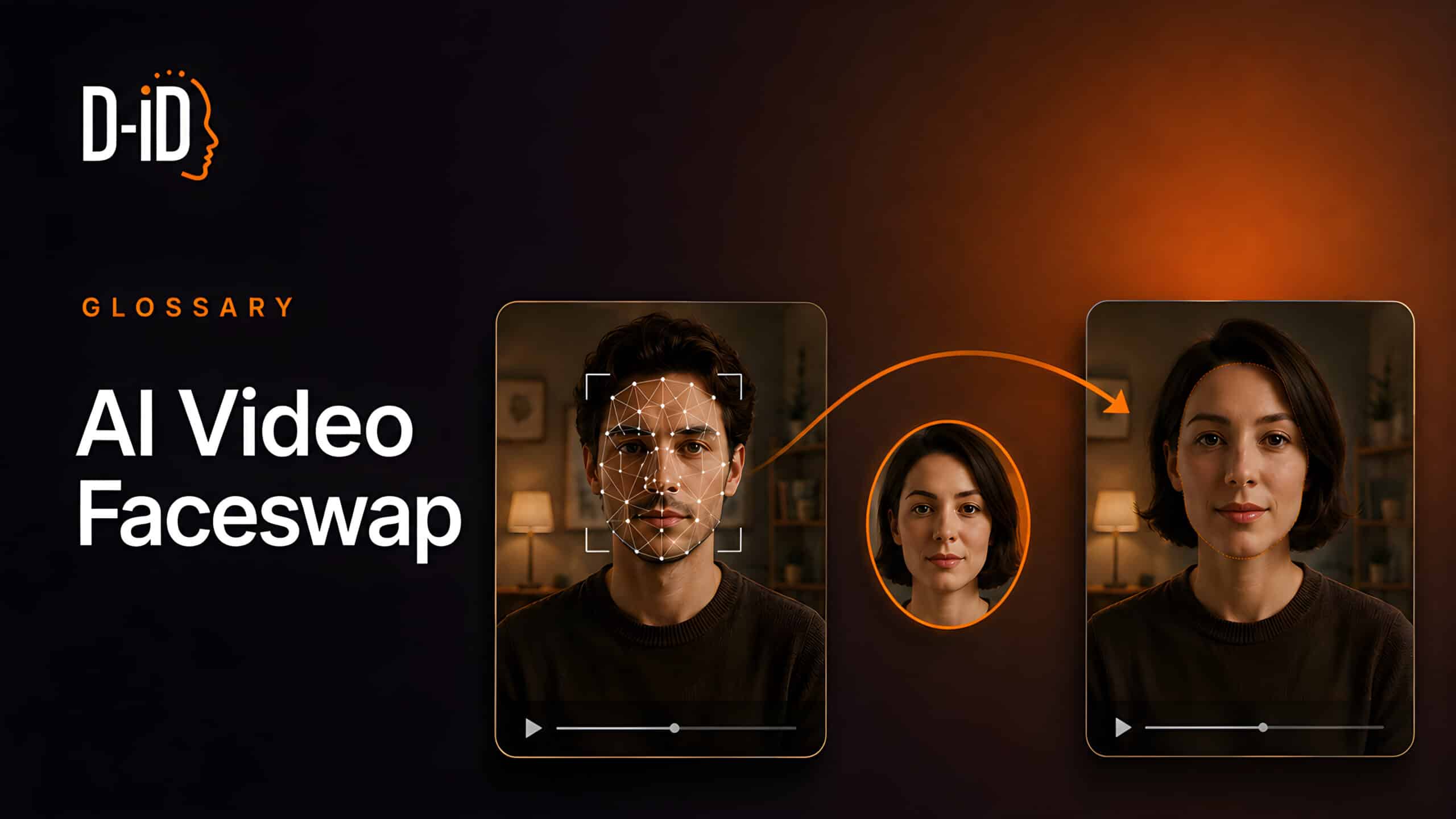
AI video faceswap is the use of artificial intelligence to replace one person’s face with another’s in moving footage. The software detects the face in each frame, maps the replacement onto it, and matches expressions and lighting automatically, so the original performance carries on under a new identity.
The same capability sits under the deepfake debate, which is why the rules matter as much as the technique. This entry in our AI video glossary covers how it works, how it differs from the terms people confuse it with, and where consent obligations begin.
What is AI video faceswap?
AI video faceswap changes the facial identity in a clip and leaves everything else as recorded: the body, the voice, the camera move, the scene. The defining difference is that it edits a performance that already exists rather than generating a new one, so there is always a source clip and a person who acted in it.
How does AI face swapping work in video?
AI face swapping runs in three stages. Detection locates and tracks the face across every frame. Expression mapping transfers the replacement identity onto the source performance, preserving mouth movements, blinks and head turns. Integration blends the result back into the footage, matching skin tone, lighting and grain.
Consistency is what makes this an AI problem rather than an editing one: face swap artificial intelligence learns a face from many angles so the identity holds from the first frame of a face swapping video to the last.
What a face swapper AI video tool can do
Tools in this category generally take an upload, a target face and a render setting, then process the clip end to end. That removes the frame-by-frame work between an idea and a finished shot, so one source video can turn into several versions instead of one. What to consider is control: a manual composite can be corrected frame by frame, while a model-driven swap gives you the output as rendered, or another render with different settings.
| AI faceswap | Manual VFX face replacement | |
|---|---|---|
| Effort | Automated across frames, often minutes to hours per clip | Frame-by-frame compositing, commonly specialist days per scene |
| Skill needed | Upload footage, choose a face, review the output | A trained compositor in professional software |
| Control | Limited. Take the output or render again with new settings | High. Any frame can be corrected by hand |
| Where it struggles | Profiles, occlusion (hands, glasses), low light, extreme expressions | Cost and turnaround, which limit how many versions get made |
AI video faceswap vs. deepfakes, avatar generation and digital twins
Three neighboring terms cause most of the confusion. Deepfake is not a separate technique but a label for synthetic or manipulated media of a real person, usually carrying the assumption that the person did not agree and that the output is meant to mislead.
Avatar generation and digital twins run the other way. Instead of moving a face onto footage someone else recorded, they generate new footage from a script, with a stock presenter or a likeness built from recordings of one person who agreed to it.
| AI video faceswap | Deepfake | AI avatar generation | Consent-based digital twin | |
|---|---|---|---|---|
| What changes | The facial identity in existing footage | Any manipulated likeness or voice of a real person | New footage generated from a script | New footage in one person’s likeness |
| Starting material | A source clip plus a target face | Varies with the method | A script plus a stock or created presenter | Recordings of that person, plus consent |
| Role of consent | Needed for legitimate use, often missing in the wild | Typically absent, which is the defining problem | Performers consent to the stock library | Explicit, documented, part of the setup |
| Typical use | Dubbing, continuity fixes, entertainment | Fraud, harassment, disinformation, satire | Training, marketing, support content | Spokesperson video at scale |
Common use cases for AI video face swapping
A common use case is scaling one good performance: a single spokesperson video adapted for another market without booking a reshoot.
Personalization is a growing one. Teams searching how to edit faces into videos usually want a familiar presenter adapted per region or per learner, a shift that also shows up in AI-generated corporate training videos.
Film and television use face replacement for continuity, such as de-aging a performer or finishing a scene where a stunt double stood in.
When faceswapping is the wrong tool
Faceswapping needs footage that already exists. If nobody has performed the scene there is nothing to swap onto, and a script-driven avatar or an actual shoot is the better route.
It also changes only the face. The voice and the body language still belong to the original performer, so a swap laid over a mismatched performance reads as wrong even when the render is clean.
Two situations rule it out whatever the quality: when you cannot document consent and usage rights for the context you intend, and when a platform or a regulator expects a disclosure you are not prepared to give. Published work also needs a human review pass, because models slip on profiles, occlusion and low light in ways that show up only on playback.
Consent, disclosure and the law
Everything above assumes the person whose face appears has agreed. Without consent, the same technique produces the deepfakes the current rules are aimed at.
The US TAKE IT DOWN Act, signed May 19, 2025, made publishing non-consensual intimate deepfakes a federal crime, with prison terms and a 48-hour takedown duty for platforms.
In the EU, AI Act Article 50 has applied since August 2, 2026: whoever deploys a system that generates or manipulates video must disclose that the content is artificial, with narrow exceptions for evidently artistic or satirical work. Neither rule bans the technique. Both turn on who is depicted, whether that person agreed, and whether the audience is told.
So the practical first step comes before any tool comparison: write down whose face appears, what they agreed to in writing, and how the video will be labeled. That usually settles whether faceswapping, avatar generation or a reshoot fits.
How D-ID approaches this
D-ID does not sell a faceswap tool. Its platform generates video from consent-based avatars instead, which is a different starting point: the footage is made with the depicted person’s participation rather than borrowed from someone else’s clip.
A V3 Instant Avatar is built from about a minute of video the person records themselves, and cannot be created until they record a consent statement on webcam, which D-ID’s system checks against the avatar footage by face and voice matching. V4 Expressive Avatars, the current stock library, come from recordings of contracted performers, and the same V4 models drive Agentic Videos, where a viewer can pause a video and ask the presenter a question.
For a team that arrived looking for a faceswap workflow, the practical difference is where the footage comes from. The presenter sits for one recording, after which the script can change without a new shoot, and no face is moved onto a clip its owner was never part of.
D-ID’s ethics pledge commits the company to writing ethical-use clauses into customer terms and suspending anyone who breaks them. It was drawn up with privacy experts including Dr. Ann Cavoukian, who created Privacy by Design. D-ID also reports ISO/IEC 42001:2023 certification for AI management, lists 120+ languages for video creation, and watermarks videos on its Trial and Lite plans so viewers can tell the footage is synthetic.
FAQs
Is AI video faceswap the same as deepfake technology?
Not quite. Faceswapping is a technique; deepfake is a label for synthetic media of a real person, usually made without their agreement and meant to mislead. The same swap can be either, depending on consent and disclosure. Regulators use the label too: the EU AI Act attaches disclosure duties to deepfakes rather than banning the technology.
Do I need technical skills to face swap a video using AI tools?
No. These tools put the whole pipeline behind an upload-and-select flow, so anyone with a browser can learn how to face swap a video in minutes. Traditional face replacement needs professional compositing skills and specialist software, which is the gap the automation closed.
Can AI video faceswap be used for commercial marketing campaigns?
Yes, with two conditions: documented consent from the person whose face appears, including commercial usage rights, and disclosure where regulation requires it, as the EU AI Act now does. Many brands meet both by building campaigns on consent-based avatars instead of swapped footage.
How realistic are AI-generated face swapping videos?
Very realistic under good conditions: frontal angles, even lighting and one clear face can produce results most viewers cannot flag. Quality drops with profile views, occlusions like hands or glasses, and extreme expressions, which cause flickering edges. That realism is why disclosure rules exist.
What are the legal risks of editing faces into videos without permission?
Substantial and growing. In the US, the TAKE IT DOWN Act of May 2025 makes publishing non-consensual intimate deepfakes a federal crime, carrying up to two years in prison for adult victims and three where a minor is depicted. In the EU, the AI Act requires deployers to disclose manipulated video, and unauthorized commercial use can breach publicity rights.
Was this post useful?
Thank you for your feedback!