
AI Avatar Agent
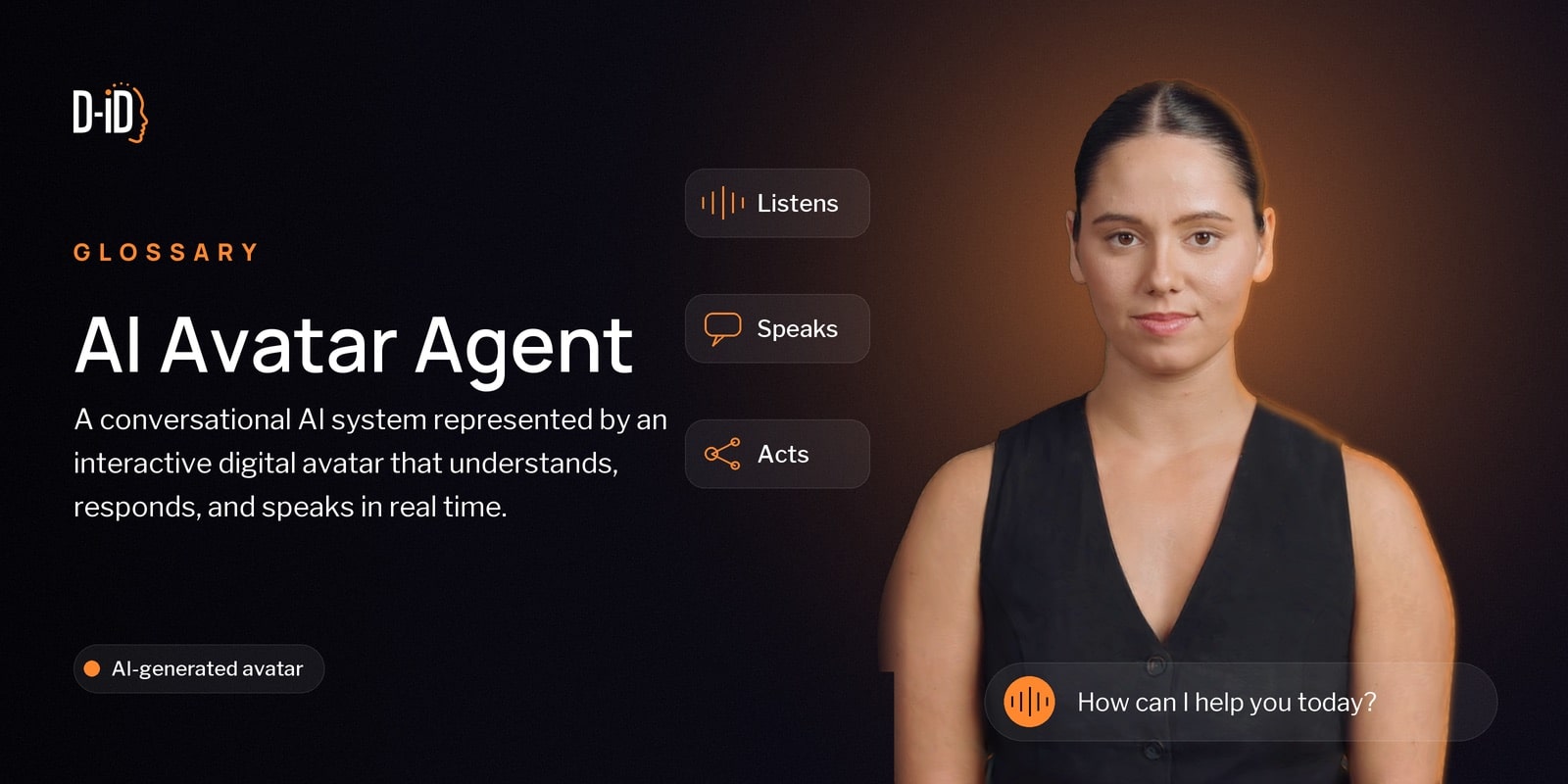
An AI avatar agent is a conversational AI system represented by an interactive digital avatar. It can understand spoken or written input, generate responses using a large language model (LLM) and relevant knowledge sources, and deliver those responses through speech, lip sync, and facial animation in real time.
Unlike a traditional AI avatar video, which presents pre-written content, an AI avatar agent responds dynamically to each user. More advanced agents can also connect to external tools and systems to perform actions, turning the avatar into a visual interface for agentic AI.
What Is an AI Avatar Agent?
An AI avatar agent combines conversational AI with a digital human interface. Instead of interacting with a chatbot through text alone, users can speak to or type questions to an avatar that listens, responds, and reacts in real time.
The system typically brings together several technologies:
- A large language model (LLM) interprets questions and generates responses.
- Retrieval-augmented generation (RAG) can retrieve relevant information from a knowledge base or connected sources.
- Speech recognition converts spoken questions into text.
- Text-to-speech (TTS) turns generated responses into spoken language.
- Real-time avatar animation synchronizes voice, lip movement, and facial expressions.
- Tools and APIs can allow more advanced agents to retrieve information or perform actions in external systems.
This makes an AI avatar agent different from a standard digital presenter. A traditional avatar delivers predetermined content. An AI avatar agent generates its response at the moment of the interaction based on the user’s input, its instructions, and the information available to it.
How Do AI Avatar Agents Work?
An interaction with an AI avatar agent typically follows five steps:
- The user provides input. The interaction begins with a spoken question or written message.
- The AI interprets the request. A language model processes the user’s intent, the conversation history, and any instructions that define the agent’s role or behavior.
- Relevant information is retrieved. If the agent is connected to a knowledge base, RAG can identify relevant information from documents, websites, databases, or other sources. More advanced agents may also call APIs or other tools.
- A response is generated. The language model creates an answer based on the available context and retrieved information.
- The response is delivered through the avatar. Text-to-speech and real-time animation turn the generated answer into a spoken response with synchronized lip movements and facial expressions.
This process repeats throughout the conversation, allowing the agent to respond to questions that were not individually scripted in advance.
What Can AI Avatar Agents Do?
Capabilities vary between platforms, but common features include:
Real-time conversation
AI avatar agents respond dynamically instead of playing a pre-rendered video. This enables natural back-and-forth interactions similar to a video conversation.
Knowledge-grounded answers
Agents can use RAG to retrieve information from approved knowledge sources before generating a response. This is especially useful when an organization wants the agent to answer questions about its own products, policies, services, or training materials.
Personalized behavior
Organizations can define an agent’s role, personality, tone, appearance, and voice. Instructions can also determine how the agent should respond in different situations.
Multilingual communication
Depending on the platform and underlying AI models, one agent can communicate with users in multiple languages without requiring a separately recorded video for every language.
Real-time visual communication
Speech is combined with synchronized lip movement, facial expressions, and avatar animation, adding a visual communication layer that text-based chatbots do not provide.
Actions and integrations
More advanced AI avatar agents can connect to APIs, webhooks, and business systems. This allows them to go beyond answering questions and potentially perform tasks such as retrieving account information, collecting data, qualifying leads, or triggering workflows.
AI Avatar Agents vs. Traditional AI Video Avatars
Both technologies use digital avatars, but they are designed for different types of communication. Understanding AI agents vs. AI avatars helps clarify where each approach fits.
| Traditional AI video avatar | AI avatar agent | |
|---|---|---|
| Output | Pre-rendered video | Live audiovisual response |
| Content | Based on a fixed script | Generated dynamically |
| Interaction | One-way playback | Two-way conversation |
| Knowledge | Information included in the script | Can retrieve information from connected knowledge sources |
| Response to questions | Cannot respond dynamically | Generates responses based on user input |
| Actions | Typically none | May use tools, APIs, or external systems |
| Best for | Training videos, announcements, marketing content | Support, advising, simulations, interactive learning |
An AI video avatar is therefore better suited to information that needs to be communicated consistently to every viewer. An AI avatar agent is designed for situations where the user’s questions, needs, or next steps cannot be predicted in advance.
Business Use Cases for AI Avatar Agents
AI avatar agents can be useful wherever organizations need to provide information or guidance through interactive conversations.
Customer support
A visual agent can answer frequently asked questions, explain products or services, guide users through processes, and direct more complex cases to the appropriate human contact.
Learning and training
Learners can ask questions rather than simply watching a course from beginning to end. AI avatar agents can also simulate conversations, allowing employees or students to practice situations such as customer interactions, interviews, or consultations.
Sales and product guidance
An agent embedded on a website can answer product questions, help visitors find relevant information, qualify their needs, and guide them toward an appropriate next step.
Internal communications
Employees can interact with agents trained on company policies, onboarding materials, benefits information, or internal documentation instead of searching manually through multiple resources.
Simulations and role-play
Because the agent generates responses dynamically, it can represent a customer, patient, employee, or other role in realistic practice scenarios.
Example: D-ID Visual Agents
D-ID Visual Agents combine real-time digital avatars with conversational AI, customizable knowledge, and integrations with external systems. Organizations can configure an agent’s appearance, voice, personality, role, and knowledge and connect webhooks to API endpoints so the agent can carry out actions as part of a conversation.
D-ID reports response accuracy of more than 90% with response times under two seconds for its Visual Agents. Knowledge can be added through uploaded documents or website content, while API implementations can connect agents to additional models and systems.
One real-world example comes from SIU School of Medicine, which uses D-ID’s real-time avatar technology to create virtual AI patients. Medical students can interview characters such as “Randy Rhodes,” who responds dynamically to their questions. The simulation allows learners to practice clinical conversations before interacting with real patients.
FAQ
Can AI avatar agents respond in real time?
Yes. AI avatar agents generate and stream responses during the interaction rather than rendering a complete video beforehand. Actual response time depends on the platform, language model, network connection, and other components of the system.
How are AI avatar agents different from chatbots?
Both can use a language model and the same underlying knowledge sources. A chatbot primarily communicates through text, while an AI avatar agent adds voice, speech recognition, facial animation, and a visual digital persona. Some avatar agents can also connect to tools and external systems.
Do AI avatar agents use a fixed script?
Not in the same way as traditional avatar videos. Their role, behavior, and tone can be defined through instructions, but individual answers are generated dynamically based on the conversation and available information.
Can AI avatar agents use company-specific information?
Yes. Many platforms allow organizations to connect a knowledge base containing information such as product documentation, policies, training materials, or FAQs. Retrieval-augmented generation can then use relevant information from those sources as context when generating an answer.
Can AI avatar agents perform actions?
Some can. More advanced agents can connect to APIs, webhooks, or other tools, allowing them to interact with external systems rather than only generate answers. The available actions depend on the platform and its integrations.
Are AI avatar agents customizable?
Yes. Depending on the platform, organizations can customize elements such as the avatar’s appearance, voice, language, personality, role, behavior, and knowledge. Customization can help adapt the same underlying technology to different brands and use cases.
Was this post useful?
Thank you for your feedback!