
10 Best Sora Alternatives in 2026
Key Takeaways
- Sora helped popularize cinematic text-to-video AI, but its discontinuation makes alternatives more important for business teams.
- D-ID is the top Sora alternative for teams that need talking AI avatars, digital human presenters, and real-time visual agents.
- The best AI video tool depends on the use case, not only on visual quality.
Sora helped define the modern text-to-video AI category. It showed how a simple prompt could become a cinematic scene with realistic motion, detailed environments, and creative camera movement. But in 2026, the search for Sora alternatives has become more practical and more urgent.
OpenAI has announced that the Sora web and app experiences were discontinued on April 26, 2026, while the Sora API is scheduled to be discontinued on September 24, 2026. For teams that need reliable video workflows, long-term availability now matters just as much as output quality.
The right Sora alternative depends on what you need to create. Some teams need cinematic AI clips. Others need talking AI avatars, digital human presenters, explainer videos, training content, localization, or real-time customer-facing agents.
This guide compares 10 of the best Sora alternatives in 2026 and explains which AI video generator fits which use case.
Why Teams Are Looking for a Sora Alternative
Sora was built around cinematic video generation. For creative experimentation, that made it an important text-to-video AI tool. But business teams often need a different kind of video platform.
- Access. With Sora’s web and app experiences already discontinued and the API scheduled to follow in September 2026, teams need tools they can rely on for ongoing production.
- Presenter support. Sora is not mainly designed for AI avatars, training hosts, digital presenters, or customer-facing visual agents. That limits its usefulness for teams creating onboarding videos, product explainers, sales enablement content, or multilingual internal communications.
- Content control. Like all major AI systems, Sora operates within strict usage and safety policies. That is necessary, but business teams still need to understand what they can create, how content can be used, and whether the tool fits their brand, legal, and compliance needs.
- Sora is not a real-time communication platform. It can generate video, but it does not let a learner, customer, or prospect speak with an AI presenter in a live conversation. Teams that need real-time interaction need tools built for that purpose.

What to Look for in a Sora Alternative
Before choosing a Sora alternative, define what kind of output your team actually needs.
Output quality
Look at realism, motion quality, lip sync, consistency, prompt accuracy, and scene control. For cinematic generation, visual quality is critical. For business communication, clarity and trust matter just as much.
Availability and workflow
A strong AI video generator should be accessible, reliable, and easy to fit into your production process. Business teams need repeatable workflows, not just impressive demos.
Presenter and avatar support
If you need training content, onboarding videos, sales explainers, or customer communication, look for tools that support AI avatars, digital presenters, voice, and facial expression.
Language support and pricing
Global teams need multilingual voice, translation, localization, and flexible pricing. Costs can vary by credits, minutes, resolution, exports, seats, and enterprise features.
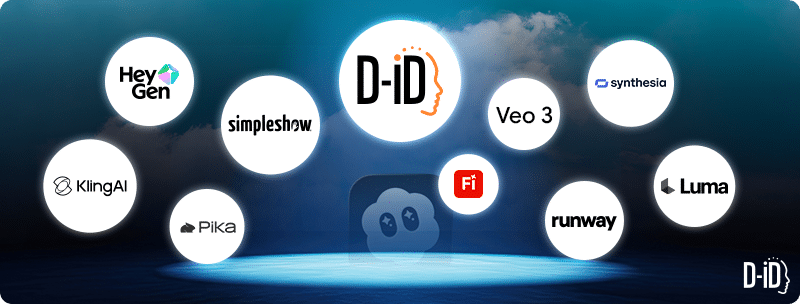
10 Best Sora Alternatives in 2026
1. D-ID
D-ID is the strongest Sora alternative for teams that need human-centered business communication. Instead of focusing mainly on cinematic scene generation, D-ID helps companies create AI avatars, digital humans, presenter-led videos, and real-time visual agents.
D-ID’s Visual Agents combine language models with expressive avatars to create natural, multilingual interactions at enterprise scale. Teams can customize appearance, voice, personality, and knowledge, then deploy agents across digital touchpoints.
Its V4 Expressive Avatars add selectable sentiments, richer facial nuance, sharper lip sync, and lower latency for smoother real-time conversations.
D-ID is ideal for training, onboarding, customer support, sales enablement, product education, and multilingual communication. If your team needs a digital human who can speak, explain, guide, and interact, D-ID is the best fit.
2. simpleshow
simpleshow is a strong Sora alternative for teams that need to simplify complex topics. It focuses on animated explainer videos, educational storytelling, internal communications, and training content.
Instead of generating cinematic worlds, simpleshow helps users turn ideas or existing content into structured explainer videos with or without AI avatars. Its AI video maker can generate a story, create video from text, add visuals, and support translation into multiple languages.
simpleshow is best for L&D teams, educators, internal comms teams, and companies that need clear knowledge transfer at scale.
3. Runway
Runway is one of the closest Sora alternatives for cinematic generative video. Its Gen-4 model can use visual references and instructions to create videos with consistent subjects, locations, and styles.
Runway is suited to filmmakers, creative agencies, brand teams, and marketing departments that need high-quality AI visuals, concept films, campaign assets, or experimental video content.
4. Pika
Pika is built for fast, playful, short-form AI video creation. It is popular for social content, stylized clips, creative effects, and quick visual experimentation.
Its Pikaformance model can animate images with synced sound, making them sing, speak, rap, bark, or perform with expressive facial movement and near real-time generation speed.
Pika suits creators, social media teams, and marketers who want fast, shareable AI clips rather than structured enterprise video workflows.
5. Synthesia
Synthesia is a well-known AI video platform for business. It allows teams to create videos from text using AI avatars and voiceovers in 160+ languages. Synthesia also highlights 240+ avatars and LMS integration, making it relevant for corporate learning teams.
Synthesia is best for compliance training, onboarding, employee education, and internal communications where teams need repeatable presenter-led videos.
6. HeyGen
HeyGen combines AI avatars, text-based video creation, templates, voice cloning, and video translation. Users can create videos by choosing an avatar, adding a script, selecting voice and language, and exporting a finished video.
HeyGen also offers enterprise features such as SSO, API access, bulk video generation, custom avatars, brand controls, and SOC 2 compliance.
It is a strong fit for marketing teams, sales enablement, product explainers, localized campaigns, and creator-style business content.
7. Luma AI
Luma AI is a strong choice for teams focused on cinematic visuals, realistic motion, and creative experimentation. Its Ray and Dream Machine technology supports generating cinematic videos from text, images, or clips.
Luma is useful for concept videos, product visuals, creative storytelling, and high-quality generative scenes. It is less suited to presenter-led business communication than avatar-first platforms.
8. Kling AI
Kling AI is another powerful Sora alternative for generative video. Kling 3.0 supports video generation, image generation, sound generation, effects, and multimodal creative workflows. Its official platform describes native audio, multimodal instruction parsing, and strong consistency across complex scenes.
Kling is best for creators and teams that want cinematic AI video, advanced motion, and more experimental generative workflows.
9. Google Veo
Google Veo is one of the strongest Sora alternatives for high-quality generative video. Veo 3 offers expanded creative controls, native audio, and extended video capabilities, while Google’s developer documentation describes Veo 3.1 as supporting high-fidelity video with natively generated audio.
Veo is a good fit for developers, creative teams, and organizations already working within Google’s AI ecosystem.
10. Adobe Firefly Video
Adobe Firefly Video is a strong option for creative teams that want AI video inside a broader production workflow. Adobe describes Firefly’s AI video generator as a tool for turning text prompts, images, or reference clips into video, including B-roll, product visuals, and creative effects. Adobe also positions the Firefly Video model as commercially safe.
Firefly is best for marketers, designers, and creative teams already using Adobe tools.
How to Choose the Right AI Video Tool for Your Use Case
The best Sora alternative depends on what your team needs the video to do: explain, train, sell, support, localize, or interact in real time.
1. Define your main goal
Start with the use case. Are you creating training content, product explainers, marketing videos, customer support assets, or social clips?
For business communication, clarity matters as much as visual quality. If the goal is to help people understand and act, choose a tool built for structured, repeatable communication.
2. Decide whether you need a human-like presenter
If your video needs to build trust, explain complex topics, or guide viewers through a process, an AI avatar or digital presenter can make the message feel more direct and personal.
D-ID is especially strong here, with AI avatars, expressive digital humans, and visual agents designed for presenter-led business communication.
3. Check your localization needs
Global teams need more than basic video generation. Look for multilingual voice, translation, localized delivery, and workflows that let you adapt one message across markets.
This is especially important for training, onboarding, product education, and international marketing.
4. Consider whether the video should be interactive
Some use cases need more than a finished video. Learners may have questions. Customers may need support. Prospects may want guidance.
For these scenarios, choose a platform that supports real-time interaction. D-ID’s visual agents can speak, listen, respond, and guide users in live conversations.
5. Match the tool to your workflow
Finally, check whether the platform fits your team’s daily work. Can non-technical users create videos? Does it support branding, messaging control, scalability, and repeatable workflows?

FAQ
-
Sora is powerful for cinematic text-to-video AI, but it is not mainly built for enterprise communication. Key limitations include discontinued or limited access, no native focus on AI avatars or presenters, content restrictions, and no real-time conversational video experience for training, sales, or customer support.
-
Many Sora alternatives offer self-serve access, including D-ID through supported products. Availability still depends on region, plan, product tier, and enterprise requirements, so teams should always check current access before committing.
-
D-ID is the best Sora alternative for teams that need talking AI avatars, digital human presenters, and real-time visual agents. It is built around human communication rather than cinematic scene generation, making it especially useful for training, onboarding, customer support, sales enablement, and multilingual business communication.
-
Sora is strong for cinematic video generation, but enterprise teams often need more than visual output. Tools like D-ID support structured business workflows such as avatars, training videos, localization, explainer content, and customer communication.
-
Yes. Several Sora alternatives can generate videos with talking human presenters. D-ID, is relevant for AI presenter videos. D-ID also supports interactive digital humans and real-time visual agents, which makes it useful when teams need both video content and human-like AI interaction.
Was this post useful?
Thank you for your feedback!