
Synthesia Alternatives: Which AI Video Platforms Go Beyond Presentation-Style Avatars?

Key Takeaways
- AI video in 2026 is about presence, not just presentation.Clear speech and polished visuals are no longer enough. What builds trust today is timing, expression, and delivery that feels aligned with the message.
- Presentation-style avatars don’t scale across modern use cases.Tools built mainly for scripted delivery struggle once avatars are reused across onboarding, FAQs, support, or interactive guidance.
- Long-term flexibility matters more than first impressions. The real test of an AI video platform is whether it can grow with your needs, more teams, more formats, more interaction, without forcing you to switch tools later.
- The right Synthesia alternative depends on communication maturity. Standardized training teams may stay with presentation-first tools. Organizations aiming for expressive, interactive, and scalable communication need platforms designed for evolution.
For years, Synthesia gave teams a reliable way to turn scripts into clean, multilingual videos for training, onboarding, and internal updates. For many organizations, it became the baseline.
AI video is no longer just a production shortcut. It is part of how companies teach, explain, support, and represent themselves. And that shift exposes an important question:
Is a presentation-style avatar still enough?
For many teams, the answer is increasingly no. This article looks at the most relevant Synthesia alternatives and explains which platforms are better suited once AI video moves beyond static delivery.
Where Synthesia Starts to Show Its Limits
Synthesia does exactly what it was built for: turning scripts into clean, scalable avatar videos. The problem is not quality. The problem is scope.
As expectations for AI video change, four structural limits become hard to ignore.
1. The Emotional Ceiling
Synthesia avatars look polished, but they behave the same way, every time.
Facial movement, timing, and expression follow a fixed animation pattern. Lip sync is accurate, yet emotional nuance rarely changes with context. As a result, delivery often feels neutral, even when the message should feel confident, reassuring, or urgent.
Why this matters: In leadership messages, onboarding, or high-stakes communication, how something is said shapes trust as much as what is said. When expression does not match intent, audiences sense artificiality. Not consciously but instinctively. That is where engagement drops.
2. The Render Wall
Synthesia is built to render videos, not to hold conversations.
Every interaction must be generated as an MP4 file before it can be used. That works for one-way delivery. It breaks down the moment interaction enters the picture.
In practice: If an avatar needs to listen, respond, or guide users in real time, rendering becomes a hard stop. Waiting minutes for a video output is incompatible with conversational AI. For live or adaptive use cases, render-based platforms hit a structural wall.
3. Custom Faces, Generic Behavior
Creating a custom avatar in Synthesia gives you a familiar face but not a unique presence.
Under the surface, all avatars rely on the same standardized movement and gesture system. The result: different faces, same behavior.
The trade-off: You gain visual branding, but lose personality. Over time, content starts to feel templated, even when the avatar is custom. For brands that care about tone, presence, and differentiation, this becomes a noticeable limitation.
4. Isolated Video Content
Synthesia is designed as a closed production tool. Its API helps automate video creation, not live delivery.
That means videos live as files, separate from user data, context, or applications.
Why enterprises feel the friction: As usage grows, teams end up managing hundreds or thousands of disconnected videos. What modern organizations increasingly need instead is a streaming-first approach: Avatars embedded directly into websites, apps, CRMs, or support flows, where content can react to users in real time.
The Bigger Picture
None of this makes Synthesia a bad tool. It makes it a presentation-first tool.
Teams start looking elsewhere when avatars are expected to do more than present, when they need to explain, guide, respond, and represent a brand across multiple touchpoints.
That shift is what drives organizations to explore Synthesia alternatives.

How to Evaluate Synthesia Alternatives: A Practical Guide
When comparing AI avatar platforms, demos and feature lists often look similar. Most tools perform well in short, scripted examples. The real differences emerge when avatars are used regularly, by different teams, and for different types of communication.
A more useful way to evaluate Synthesia alternatives is to focus on how you plan to use avatars in practice. Today and over time. The questions below help clarify which capabilities actually matter for your use case, and which type of platform is likely to fit best.
1. How long does the avatar need to hold attention?
If your videos are short and fully scripted, presentation-style delivery may be enough. If avatars need to explain complex topics or appear frequently, timing, expression, and presence matter more.
2. Who needs to work with the avatar tool?
If avatar content is created by a single team, simple tools are often sufficient. If multiple teams, such as marketing, L&D, or support, need access, collaboration, permissions, and consistency become important.
3. How much control do you need beyond templates?
Templates speed up production but they also set limits. If brand tone, delivery style, or scene dynamics matter, check how much control the platform offers once templates no longer suffice.
4. Is your use case static or adaptive?
Pre-recorded video covers many needs. If interaction or context-aware responses are part of your roadmap, choose a platform that can support conversational content without switching tools later.
5. What happens when usage grows?
Consider scale early. Can the platform support more videos, languages, and teams with predictable workflows, integrations, and costs?
There is no single “best” Synthesia alternative. Presentation-first tools work well for standardized delivery. Platforms built for expressiveness, reuse, and adaptability are better suited for evolving communication needs.
The right choice depends less on features and more on how your communication is expected to grow.
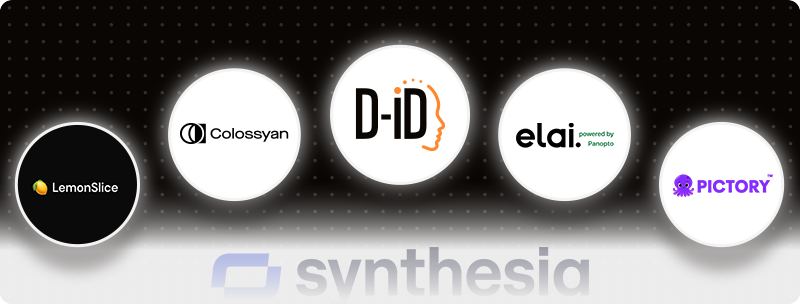
The 5 Most Relevant Synthesia Alternatives
1. D-ID
D-ID is best understood not as a traditional video tool, but as a platform for expressive, AI-driven digital humans.
Unlike presentation-first solutions, D-ID uses the same core technology for both high-quality explainer videos and real-time, conversational avatars. This allows teams to reuse avatars across training, onboarding, customer support, and interactive experiences without switching tools or rebuilding workflows.
D-ID avatars are trained on real human performances, resulting in more natural facial movement, timing, and emotional expression. Combined with broad language support, flexible customization, and enterprise-ready APIs, the platform is often chosen by organizations that see AI avatars as a long-term communication layer rather than a static video format.
2. Colossyan
Colossyan is strongly oriented toward learning and development use cases. Its platform is designed to support structured training content, with a clear emphasis on instructional clarity, script logic, and educational flow.
For L&D teams producing internal training, compliance modules, or standardized learning videos, this focus can be a real advantage. The workflow encourages consistency and makes it easier to roll out training content across teams.
As a broader Synthesia alternative, however, Colossyan is less flexible. Marketing communication, customer-facing content, or interactive scenarios are not its primary design targets. Teams looking to reuse avatars across departments or move toward more adaptive communication may find the platform limiting over time.
3. Elai
Elai is commonly used for multilingual onboarding, product explanations, and internal communication. The platform supports standardized avatar video production across regions and languages, making it a practical option for globally distributed teams.
Its strength lies in covering the core requirements of presentation-style avatar videos: script-based delivery, language support, and repeatable workflows. For many organizations, this is sufficient for explainers and onboarding content.
However, when requirements go beyond standardized delivery, such as stronger emotional expression, interactive elements, or brand-specific presentation styles, teams may encounter limitations. Elai works well as a scalable production tool, but offers less flexibility for more advanced communication scenarios.
4. Lemon Slice Studio
Lemon Slice Studio focuses on speed and simplicity. Users can quickly generate lip-synced avatar videos from a single image and a script, without complex setup or configuration.
This makes the platform suitable for quick, lightweight videos or experimental use cases where ease of use matters more than control. It can be a good fit for individuals or small teams producing occasional content.
At the same time, Lemon Slice Studio is not designed for enterprise-scale workflows. Advanced customization, integrations, and interactive or real-time communication are outside its scope, which limits its suitability for long-term or multi-team deployments.
5. Pictory
Pictory takes a different approach to AI video. Instead of focusing on avatars, it specializes in turning text-based content into video automatically, often using stock visuals and templates.
This makes it effective for content repurposing, such as transforming blog posts or articles into short videos for distribution. For teams focused on reach and efficiency, this can be a useful capability.
As a Synthesia alternative, however, Pictory does not address avatar-based communication. It is not designed to create a human presence, guide users, or represent a brand through a digital spokesperson, which makes it less relevant for avatar-driven use cases.

Final Takeaway
Synthesia remains a solid choice for structured, scripted video delivery. But in 2026, many teams are moving beyond that model.
If your goal is to build trust, enable interaction, and reuse avatars across multiple communication formats, platforms like D-ID are better aligned with where AI video is heading.
The right alternative is less about replacing Synthesia feature by feature and more about choosing a platform that won’t limit what your video strategy can become.

FAQ
-
Synthesia is best suited for scripted, presentation-style avatar videos, such as internal training, compliance content, and standardized updates. It works well when communication is one-way and does not need to adapt to users or context.
-
Expressiveness affects trust, attention, and credibility. In onboarding, leadership messages, or customer-facing communication, audiences respond to facial cues, timing, and emotional alignment, not just spoken words. When delivery feels flat or mismatched, engagement drops even if the content is correct.
-
No. Synthesia is built around rendered video output. Each interaction must be generated as a video file before use, which makes real-time or conversational interaction technically impractical. D-ID is the best solution when it comes to real-time interactive avatars.
-
Presentation-style avatars deliver pre-scripted content in a one-way format, similar to narrated videos. Conversational avatars are designed to listen, respond, and adapt in real time, acting as an interactive communication interface rather than a static video output.
-
As usage grows, managing large libraries of static video files becomes inefficient. Content is harder to update, reuse, or personalize. This is why many enterprises shift toward streaming or infrastructure-first approaches, where avatars are embedded directly into digital products and can adapt dynamically.
-
Next-generation platforms treat avatars as a communication interface, not just a video format. They combine expressive delivery, reuse across scripted and interactive scenarios, and infrastructure that integrates directly into websites, apps, or support systems, capabilities offered by platforms such as D-ID.
-
No. Synthesia is optimized for pre-recorded avatar videos. Interactive or real-time use cases, such as website assistants, guided onboarding, or live support, require platforms built around streaming or conversational avatars.
-
In some cases, yes. Platforms that support both scripted explainer videos and interactive avatars can reduce tool sprawl by covering multiple communication needs with the same underlying technology, rather than separating video production from live interaction.
Was this post useful?
Thank you for your feedback!