
How D-ID’s LiveKit Plug-in Turns AI Agents into Real-Time Visual Experiences
Key Takeaways
- The D-ID LiveKit plug-in makes it easy to add real-time, human-like avatars to AI agents
- It places D-ID directly inside one of the fastest-growing ecosystems for real-time AI development
- Developers can use D-ID as a drop-in visual layer within their agent pipelines
- D-ID stands out through expressive, performance-based realism in live interactions

The Shift Toward Real-Time AI Agents
AI is moving beyond static outputs.
Instead of generating text or pre-recorded video, modern systems are built around real-time interaction. Users expect responses that feel immediate, contextual, and continuous. That’s a fundamentally different experience from traditional content.
Frameworks like LiveKit are enabling this shift. LiveKit acts as the infrastructure layer for real-time AI applications, handling streaming, orchestration, and communication between different components.
To make this system flexible, LiveKit introduced a plug-in architecture.
What Are LiveKit Plug-ins?
LiveKit plug-ins allow developers to connect external services directly into the agent pipeline.
Instead of building every capability from scratch, teams can assemble their systems by combining specialized providers for each layer of the experience. This makes development faster, more flexible, and easier to scale.
A typical setup might include:
- an LLM for reasoning and decision-making
- speech-to-text and text-to-speech for voice interaction
- an avatar provider for the visual layer
What makes this approach powerful is how these components work together in real time. Each service focuses on what it does best, while LiveKit handles the orchestration, streaming, and communication between them.
For developers, this means they no longer have to manage complex infrastructure or deeply integrate every piece themselves. Instead, they can swap components in and out depending on their needs. Want to test a different voice provider? Replace it. Want to upgrade the visual experience? Plug in a new avatar solution.
This modularity changes how AI systems are built.
Rather than creating monolithic applications, developers are now assembling dynamic pipelines that can evolve over time. It becomes easier to experiment, iterate, and improve individual parts of the system without rebuilding everything.
That’s why plug-in architectures like LiveKit’s are quickly becoming the standard for real-time AI development. They reduce complexity, accelerate innovation, and make it much easier for new technologies — like expressive, real-time avatars — to become part of everyday applications.
What Is the D-ID LiveKit Plug-in?
The D-ID LiveKit plug-in enables developers to integrate D-ID avatars directly into real-time AI agents built on LiveKit.
In practical terms, D-ID becomes the visual interface of the agent — the layer users actually see and interact with.
Instead of setting up a custom integration with D-ID’s streaming API, developers can now:
- add a real-time talking avatar in just a few lines of code
- plug D-ID into an existing LiveKit agent stack
- instantly turn voice or text agents into visual, human-like experiences
This dramatically reduces the effort required to move from a functional agent to something that feels engaging and intuitive. What used to take significant engineering work can now be achieved in minutes.
But the impact goes beyond speed.
By integrating through LiveKit, D-ID is no longer a standalone service that needs to be wired into a system. It becomes part of a composable architecture where each component plays a specific role. In that setup, D-ID handles the visual delivery while other services handle reasoning, voice, or data retrieval.
That separation is important. It allows developers to focus on building better agent logic and user experiences, without worrying about the complexity of real-time rendering, lip sync, or expressive behavior.
It also changes how developers think about avatars. Instead of being an optional layer added at the end, the avatar becomes a core part of the interaction design from the beginning. The question is no longer “Should we add a visual?” but rather “How should this agent present itself?”
Why This Matters
The LiveKit integration changes how and where D-ID gets used.
First, it moves D-ID directly into the developer workflow. Instead of being something added later, it becomes part of the system from the start. That alone increases adoption.
Second, it removes a major barrier. Developers don’t want complex setups. If something works quickly, they try it. If not, they skip it. The plug-in turns D-ID into a practical, low-friction option.
Third, it opens up a new distribution channel. LiveKit is becoming a default layer for real-time AI applications. By being part of that ecosystem, D-ID is now:
- visible where developers are already building
- comparable to other avatar providers in real use cases
- easy to test and integrate
That combination is powerful.
How It Works
The architecture is clean and intentionally simple.
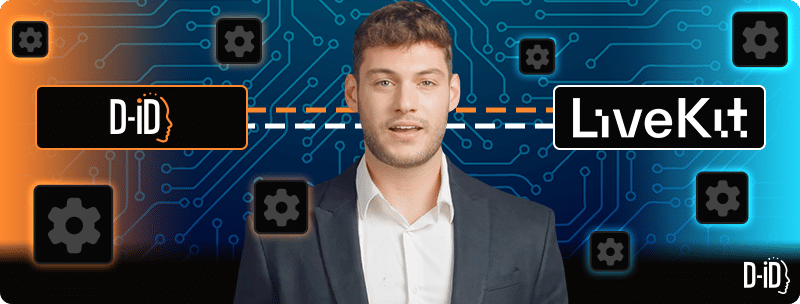
LiveKit runs the real-time agent pipeline. It manages sessions, streaming, and communication between all components. The D-ID plug-in connects into this pipeline as the visual layer.
The flow looks roughly like this:
- The agent generates audio (via TTS or voice input)
- The audio is sent to D-ID
- D-ID renders the avatar in real time
- Video and audio are streamed back into the LiveKit environment
D-ID’s backend handles the complex parts like lip sync, facial expressions, and video generation. Developers don’t have to manage any of that themselves.
Where D-ID Stands Out
There are multiple avatar providers in the LiveKit ecosystem. The difference shows up quickly in real-time use.
D-ID’s strength lies in expressiveness. The avatars are not just speaking — they react with tone, timing, and subtle facial cues that feel more natural. In live interactions, that makes a noticeable difference.
It’s also important that D-ID is built for real-time scenarios. Some providers originate from pre-rendered video workflows and adapt them for live use. D-ID approaches this from the other direction, focusing on low latency and conversational flow from the start.
And this plug-in is not a standalone feature. It fits into a broader direction that includes:
- AI video creation
- real-time conversational agents
- interactive, agent-driven video experiences
That’s a much bigger play than just “avatars.”
Who This Is For
The LiveKit plug-in is clearly aimed at developers and technical teams.
It’s designed for people building:
- real-time AI agents
- conversational interfaces
- voice-driven applications
It is not intended for no-code users or traditional content workflows. And that’s a good thing. It shows a deliberate move toward a more technical audience that is shaping the next generation of AI products.

The Bigger Picture
This integration reflects a broader shift in how digital experiences are evolving.
We’re moving from static content to interactive systems. Video is no longer just something you watch. It becomes something you can engage with.
By integrating into LiveKit, D-ID positions itself right at the center of this shift. Not as an add-on, but as a core building block for real-time AI experiences.

FAQ
-
The D-ID LiveKit plug-in lets developers add real-time, human-like avatars to AI agents built on LiveKit. It acts as the visual interface of the agent.
-
It removes the need for custom streaming setups. Instead of building everything yourself, you can plug D-ID into your LiveKit stack with minimal effort.
-
It’s built for developers and teams creating real-time AI agents, voice interfaces, or conversational applications.
-
You can create interactive experiences like AI support agents, virtual assistants, onboarding guides, or product demos — all with a real-time visual interface.
-
The agent generates audio, which is sent to D-ID. D-ID renders the avatar in real time and streams the video back into the LiveKit environment.
-
No. D-ID handles rendering, lip sync, and expressions, so you can focus on the agent logic.
-
D-ID focuses on expressive, human-like delivery. Avatars don’t just speak — they react with natural timing and emotion.
-
LiveKit provides the infrastructure for real-time AI systems, making it easier to combine voice, language, and streaming into one pipeline
-
Yes. AI is moving from static content to real-time interaction, where users can engage, ask questions, and get instant responses.
Was this post useful?
Thank you for your feedback!